

Category: Marshall Ulrich

Heat Training Tips from a 20-Time Badwater 135 Finisher

Heat Training Tips

By Marshall Ulrich, 20-time Badwater 135 finisher

Are you planning to do a run or race in one of the hot deserts of the world? If so, you need to heat train! Let’s get you ready so you can put your dreams in action!

Heat training is one of my favorite subjects, as I’ve had to prepare for more than 25 crossings of Death Valley, in July, as well as other desert races.

A few things to keep in mind as you are heat training: It is possible to train, or acclimate to heat. Your body learns to sweat more, your veins come to the surface to aid in cooling, and your kidneys and lymph system learn to retain more sodium and other electrolytes. While humidity is a factor in some places, it is not much of a factor in deserts; less humidity means better evaporative cooling.

Heat training can be done anywhere, as long as you have access to a dry sauna:

  • Start heat training 6 to 8 weeks (4 weeks minimum) before your desert event.
  • Always drink plenty of water.
  • Be sure to add electrolytes (my favorite is Sustain tablets), including sodium, potassium, calcium, and magnesium.
  • Weigh yourself before and after you go in the sauna; drink at least 2 cups of fluid for every pound lost.
  • Have someone check in on you while you are in the sauna.

Here are week-by-week guidelines.

Week one: Find a dry sauna and set the heat to 180 to 200°F. Dress in swim trunks, weigh yourself, bring your water bottle and a towel to sit on and/or wipe sweat out of your eyes, and step in. Stay in about 20 minutes if you can, then step out of the sauna and take a 5 to 10 minute break at room temperature. Go back in for 15 minutes. Do this twice during the first week. You should notice some caking around your temples as you body “dumps” salt; this is normal. It is very important to drink as much as you can while you are in the sauna and during the break, including electrolytes. Finish with a cool down period/break at room temperature (continue to drink) until you feel like your temperature has returned to normal.

Weeks two and three: Go to the sauna two or three times a week. Stay in about 20 minutes, take a 5 to 10 minute break, go back in for 15 minutes, take another 5 to 10 minute break, then head back in for another 15 minutes. Finish with a cool down period. The amount of salt that your body is dumping should be decreasing, and you should be increasing the amount of water you’re drinking as your body learns to sweat sooner, and more, to cool you more effectively.

Weeks four and five: Go to the sauna three to four times a week. Stay in at least 30 minutes at a time, if you can, but continue to take 5 to 10 minute breaks. It is not necessary to exercise while in the sauna, but it helps; the simplest is to jog in place. If you want to add exercise in the sauna, this is the time to do it, as your body has begun to acclimate to the heat.

The final week(s): You should be able to stay in for about an hour with two to three 5-minute breaks, and you should be doing this three to four times a week. Your consumption of water should be almost double as you will be sweating more, sooner, for longer. Your sweat will not taste as salty.

Remember, you are stressing your body and you need to allow it to recover, so don’t drive around with the heater on in your car! This serves very little purpose and can cause serious harm if you pass out and have an accident.

An alternative to visiting the sauna is waiting until the heat of the day reaches 90 degrees and above, and run in dark sweats (top and bottom, top being most important). Start gradually as you did in the sauna and work up to about an hour and a half run. Take lots of water and drink, drink, drink, remembering to replace your electrolytes.

With both training scenarios, make sure you are peeing and monitor the color; it should be a light straw color. If it’s darker than that, you’re not drinking enough. A runny nose also signals good hydration. You can also pinch the skin on the back of your hand to check how quickly it rebounds—it should do so almost instantly; if it stays up in a tent shape, you’re not hydrating enough.

With appropriate heat training you can safely put your desert racing dreams in action!

##

The ultimate endurance athlete, Marshall Ulrich has run more than 120 ultramarathons averaging over 125 miles each, completed 12 expedition-length adventure races, and climbed the Seven Summits all on his first attempts. As of 2015, he is a 20-time finisher of the world’s toughest footrace, the Badwater 135 Ultramarathon, including winning the race in 1991, 1992, 1993, and 1996.

Marshall finished the first-ever circumnavigation on foot of Death Valley National Park, about 425 miles in one of the hottest, driest places on earth, during the most blistering month in U.S. history (July 2012). He’s ranked this expedition as tougher than ascending Mount Everest, but not as challenging as his record-setting transcontinental run of more than 3,000 miles from San Francisco to New York City, which was the subject of his memoir, Running on Empty.

In his sixties, Marshall inspires adventurers, active and armchair athletes, and a growing general audience by sharing his experiences and defying the ideas of “too far,” “too old,” and “not possible.”

More info at marshallulrich.com
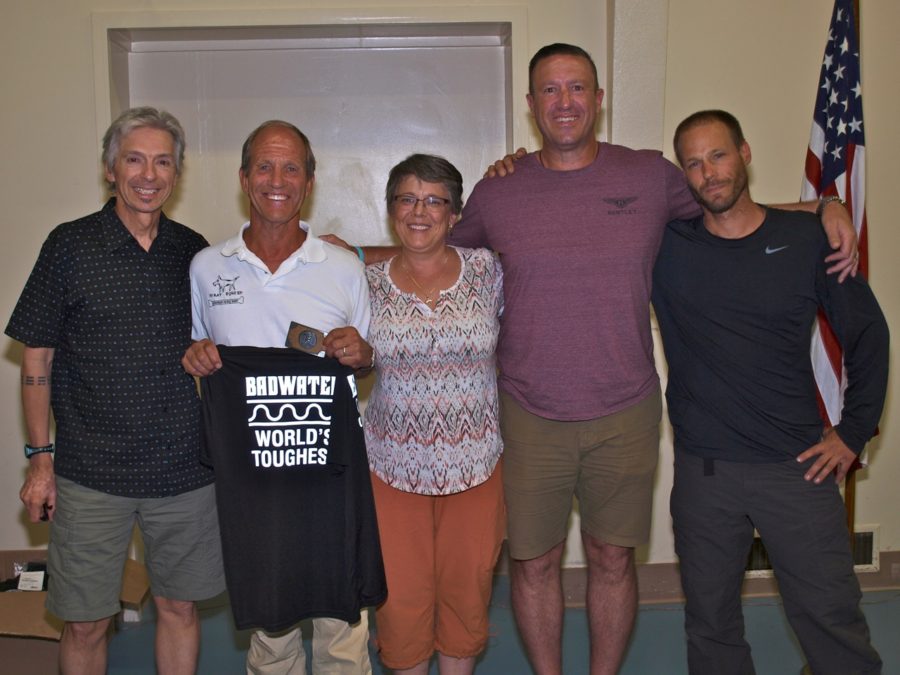
Marshall and his support team cross the Badwater 135 finish line for the 20th time in 2015!

Marshall and his support team celebrate his 20th Badwater 135 finish in 2015!

He’s Not Heavy, He’s My Brother

Crew for Marshall Ulrich and his Badwater Quad for Starving Children

I can honestly say that I had no idea what I was getting myself into when I committed to being a member of Marshall Ulrich’s crew as he attempted a Badwater Quad, an unprecedented feat of running 600 miles through Death Valley. To cover the miles, he would travel back and forth from Badwater, -282 feet below sea level, to the top of Mount Whitney, +14,500 feet above sea level, twice. The adventure sounded exciting and the opportunity to be involved in such a record-breaking event lured me in and drove me to want to add my name to the list of crewmembers. Not only was I enticed by the adventure but also by the inspiration behind the run. This was an undertaking to help raise money for the Missions of the Religious Teachers Filippini which help save the world’s starving children. Because of its inspiration I knew there was something more, something special, about this journey and about Marshall.

Although I was basically clueless about Death Valley and what exactly my role was going to be in helping Marshall, I admit that I did have two preconceived notions about the experience. First, I knew it would be hot. I also knew that in being a part of this once in a lifetime event and witnessing this extreme athletic undertaking and ultimate test of one’s own body and soul for the benefit of others, I would be changed forever. I was right on both accounts- it was hot and I have been forever changed.

After a two-hour drive from the Las Vegas Airport, Jay, David, and I arrived at our motel in Stove Pipe Wells where we were to meet Marshall, Lisa and the rest of the crew. Those we were meeting had already completed the first two legs of the journey, approximately 300 miles. Immediately upon our arrival I got a taste of what makes Death Valley so famous- high temperatures. I stepped out of the car into an oppressive heat and a strong desert wind. It was 5:00pm and I was overwhelmed by the dense, hot air that surrounded me. With such heat present in the evening, I grew anxious about being introduced to the desert heat at high noon.

The room at the Stove Pipe Wells Motel served as our race headquarters. From the outside, the room had few visible signs that this was the camp of a man who had plans to run 600 miles through the hottest place in America. The only signs of life were the few shirts and socks left out to dry in the sun. However, once I walked into the room, I entered a new world. My assumptions about this experience were confirmed as I stood in the doorway. It was going to be hot and unlike any other experience in my life.

The room was a bit of organized chaos. It was stocked with supplies that would be Marshall’s lifeline for his journey- food, cases of O2GO, extra clothes all embroidered with the North Face logo, boxes of new running shoes, a bike, and first aid kits. Although I was a bit overwhelmed by the scene, I didn’t have time to get too frazzled because a gold Chrysler mini van packed with people soon pulled up to the door. It was Marshall, Lisa and the rest of the crew. Although they were all tired and hadn’t slept in 24 hours, they greeted Jay, David, and I with smiles and hugs. Immediately my worries were eased, my fears pacified. Although I was the youngest of the group, I was welcomed with open arms, literally, big hugs from everyone. In a matter of seconds, complete strangers made me to feel like part of the family. Again my assumptions about this trip and the people involved were confirmed. These were special people and this was a special event.

At four o’clock the next morning, two mini vans filled with crew and supplies left the motel at Stove Pipe Wells to escort Marshall to the starting line of the race where his third crossing would begin. Marshall’s third crossing was in conjunction with the Badwater Ultra Marathon where he would be joined by 71 other athletes hoping to run 135 miles from Badwater to Mount Whitney. Twenty-five miles from the start, Marshall began to experience tendonitus in the left shin. Only a few miles later, the same fate befell the right shin. At this point, a plan was devised to help reduce pain and swelling. Ice, changed approximately every 20 minutes, was ace bandaged to his shins until he crossed the finish line.

As if running 600 miles through Death Valley in July does not present enough of its own obstacles, having to endure crippling pain in the legs for close to 300 miles, which include drastic changes in elevation as three major mountain ranges are crossed, adds another large hurdle. It is in the face of adversity, however, that the true character of a person is revealed. It is only the toughest of people that can stare adversity square in the eyes, then poke them out. I don’t know if Marshall Ulrich can be described as tough. That would never do him justice. I don’t think there is a word in the English language or any language for that matter that could describe this man.

Although sharp pains pierced his legs with every step, blisters appeared on his feet, the sun beat down hard on him every day, wind blew at his face, and sleep was a word missing from his vocabulary for 10 days, Marshall kept moving with a smile on his face. You would be hard pressed to remember a time that he complained or didn’t ask how everyone on the crew was holding up. In all of his pain and suffering, Marshall never lost a sense of something beyond himself- the children he was running for. In his moments of greatest suffering, it was not about him, it was about the children. For them, he pushed himself to continue even if that meant slowing from a run to a walk. Marshall offered all of his own pain to help relieve some of the suffering that these children endure every day.

As Marshall made the final turn onto the road leading back to Badwater for the last 17 miles of the Death Valley Quad, after having covered approximately 580 miles, the desert did not yield. It maintained the most vicious and unforgiving conditions. Temperatures were extreme, approaching 130 degrees and wind whipped at close to 30 miles an hour. Most mortals would have long since crumbled but Marshall pressed on and arrived at the finish line as the sun was setting 10 days and 13 hours after the start of the Quad.

No big fanfare waited for our arrival at the finish. A few photographers were present as Marshall along with his seven crewmembers walked arm in arm across an ever so appropriate ace bandage finish line. There was no need for fanfare as no fanfare or celebration could do this feat justice. A douse of champagne and a few loving words from crewmembers while Tina Turner’s “Simply the Best” played in the background was all that was needed to commemorate the finish. In his own quiet way, Marshall overcame all odds and accomplished a goal that even in the face of adversity he never dreamed of letting slip away. He taught us all a lesson about will power, determination, courage, and dedication to other people.

As Marshall was getting his picture taken after the finish, I stared out into the open desert and looked up into the blue sky filled with pink clouds as the sun quietly slipped away behind the horizon. Lisa put her arm around me and a chill ran through my body. Never before had I seen such an athletic pursuit and strong display of human will power. Marshall has shown me that there are no limitations. The human mind is a powerful thing capable of conquering anything it wants. Life is about desire. With desire, passion, strong will and help from other people, anything is possible. You just have to believe.

Click here to read Marshall’s report and to view an incredible finish line slideshow by Tony DiZinno.