Each Badwater Race Experience is Different
Keeping Track of Nutrients – Spreadsheet you can use
Click here to download this article in PDF format
Click here to download the Excel spreadsheet for nutrient tracking
Running for a Charity
There were a number of inspirational factors that led me to commit to dedicating my 2007 Badwater race to a local charity: many Badwater runners run for a charity (including Dr. Lisa Bliss, who won the 2007 woman’s race); Chris Kostman doing the Ironman Revisited each year for the Challenged Athlete Foundation; and a desire to have my life-in-retirement make a difference by giving back.
The charity was Mobius Kids in Spokane, WA, where I live. Mobius Kids is a children’s museum for young children and their families for hands-on arts, culture and science learning. The museum offers seven interactive exhibit and gallery areas along with community outreach camps, classes, programs and special events. Since opening in September 2005, Mobius Kids has hosted more than 160,000 visits.
Unfortunately, a fact-of-life for children’s museums is that they cannot make ends meet from only user fees and ticket sales. They must raise money each year from their local community and foundations to keep the doors open.
The result of my commitment was 2,000 letters going out to Mobius Kids members about my race, a mention in the monthly Mobius Kids newsletter and on their website, an interview on local TV that ran both on the morning and evening news, a blog that I created for the race (http://2007raceforkids.blogspot.com/) and $12,000 raised! This greatly exceeded my expectations, as I thought $2,000 or so would be a “good show.” I was very moved and humbled by the outpouring of support.
So, what was the impact during the race? My dedication of the race to a charity both inspired my crew and me. My crew viewed what they were doing as having a higher and additional purpose. They had to make sure they kept me going all the way to the finish line “for the kids” and often mentioned to me that we had to remember “the kids.”
As for me, during the race I often thought of the children and parents that go to Mobius Kids—the smiles on the faces of both—and how my running would assist in keeping that opportunity open for them. It kept me going. It was a clear purpose outside of a self-absorbed interest. As stated in the race blog:
Why Did I Do This Blog?
Running races like the Badwater 135 is essentially a self-focused and self-absorbed effort. While a successful race is indeed satisfying and there is for me an essential joy in running reflective of my appreciation of life, I wanted to achieve a balance—to do something for others so as to balance a self-focused effort.
I highly recommend dedicating your race to a charity. The inspiration and satisfaction that comes from knowing you can—and did—make difference is remarkable, humbling and very satisfying.
Every Race is Different
I have done the Badwater Race twice officially and once as a solo runner outside of the race. I have also started the race once, having to drop out due to a knee injury from a biking accident before the race. In addition I have volunteered, having been a course marshal and on a medical team. Consequently, I have seen the race from several perspectives.
Each race has been different, in part because of my advancing age (66 in 2007, five years after my first Badwater race in 2002), the effects of which I resist acknowledging. The solo race was by far the best in terms of energy level, freedom from pain and distress, relaxation and enjoyment. What I did miss, however, was the accompaniment of other runners. Perhaps the solo not being in a competitive environment was a big plus. The 2007 race was memorable too because of several distinct phases.
During the miles up to Stovepipe Wells, I felt good, strong, and pushed the pace a bit. However, my left hip kept hurting, and by Stovepipe Wells, every step hurt. Luckily, I had a chiropractor on my crew. He worked on my hip for about an hour until he got it fixed, and it never bothered me for the rest of the race!
Moral of the story: see if you can have at least a massage therapist on your crew, and a chiropractor if possible (but only if you have been seeing that person beforehand). Note: this may be good advice mostly for folks like me, whose “bolts” have become loose after so many years of running (first 100 miler in 1978). Try to take care of problems when they arise.
Here are comments from my crew in a spreadsheet log for this phase up to Stovepipe Wells:
- Complained of left anterior and lateral hip pain with SI immobilization.
- Left sacroiliac joint (“SI”) posterior, adjusted with blocks and activator, left adductor tight, left piriformis tight, stretch and muscle work. Dave put on SI belt. Also peed.
- Singing [ran with MP3 player].
- Time check in, picnic table massage, peed (yellow). Distraction of left hip, left inferior pubic bone, left TFL muscle work, left temporalis tight and tender.
- 124 F on asphalt with cloud-cover.
- Dave said his hands felt swollen (possibly b/c he took excessive Endurolytes). Feeling pain in his feet, legs, and body. Observed ingestion of extra pills (possibly electrolytes) from secret stash!
- Commented that it was a long damn race and wished he’d never written the blog for Mobius Kids – all with a smile.
- Got chair to sit for a 10 minutes. Said he had never felt this bad 46 miles into a run. Feels “wiped out; no energy.” Closed eyes for a few minutes. Changed shoes to Mizuno, kept same insoles. Urinated.
At Stovepipe Wells I also took the time to have a foot specialist fix a minor blister to make sure it did not get worse. Worked, never bothered me for the rest of the race.
The downside: total time at Stovepipe Wells was 1.5 hours.
The next unusual aspect was getting so very sleepy that I just had to stop and sleep about half way up the climb to Townes Pass. This happened during the 2002 race as well, and was unexpected so early into the race. I lay down on an air mattress, was out in a few minutes, and woke up two hours later, feeling refreshed and ready to go.
Total time off course: 3.5 hours. This, of course, concerned me although it seemed necessary.
Have since read somewhere that intense exercise can deplete a hormone that then lets another hormone take precedence, causing one to become very sleepy. Would love to know how to prevent this from happening again.
The sleepiness also may have been due to an allergic reaction to blowing dust and pollen.
Notes from crew:
- Exhausted; voice lower than normal (pollen and dust); throat dry; breathing hard. Reported one allergy tab helped some.
- Exhausted; wanted to sleep. Before sleep 2 scoops from double-zip bag in shaker – drank all before sleeping for two hours. Snored, very congested. Drank Cytomax Lite one scoop in 8 oz. – drank all after waking. Upon waking weight was 159 without ice scarf. Started walking again at 12:37 am. Crew could not find Hammer gel boxes.
- Hands are swollen; breathing is more difficult than usual. Sounds like head is stuffy.
During the rest of the race, including the second night, never even thought about sleeping or stopping. So, a bit of a mystery.
One of my crew, an experienced Badwater runner, George Biondic, suggested later at Panamint Springs that I climb up to the Darwin time station at a very slow pace, as the climb was deceiving. He suggested that I keep my heart rate at 50-55% of maximum or so. So I did, even though 50-55% seemed ridiculously low and slow. But, as a consequence, after Darwin I was strong and passed many runners, especially coming into Lone Pine. I saw many who were barely walking and obviously in pain, while I was feeling great. It turned out to be very useful advice, as I had one of the faster times from Lone Pine to the finish line.
Comments in crew log:
- Continues to urinate frequently – clear, good stream; Cytomax Lite drink 0.6 [drank only 0.6 of 20 oz bottle]. Question the scale reading at 166 given last reading at 162.
- As above re: urine, seems content; no reported pain; stride is strong.
- Cytomax Lite drink 0.6. Changed shoes at 2:15 p.m. midway of mile. Listening to Pink Floyd “over and over and over again.” And is it working? “Yes!” Smiles! Still urinating frequently. Put straps just below knee.
- Drink – Cytomax Lite plus previous drink mixed with D-Ribose (approx half consumed previously) plus gel. Is singing along with his music now.
- Hands still swollen.
- Does not stop. Is running.
- He is truckin [mile 115].
Last, I wanted to thank my crew with a gift that they would appreciate, beyond my many verbal thanks. Fortunately two of my crew took some wonderful pictures of the adventure and I found a site that makes putting together a “coffee table” picture book a breeze; Picaboo:
I put together a book that was focused mostly on my crew’s experience and their contribution, rather than on me. It was a hit with them. You can view it at:
Post script: kept changing shoes in the race, as my right foot hurt. Found out after the race that I had been running with a stress fracture of the fifth metatarsal.
Hope the above may assist some.
Keeping Track of Nutrients – Spreadsheet you can use
One of the mysteries of running in very hot weather is how many electrolyte tablets to take. With a constant intake of water, if one takes too little sodium (“Na”) one can gain weight as one has a too dilute a concentration of Na in the blood for the body to excrete excess water. One has “too much water on board relative to sodium” (this, by the way, is from Dr. Lisa Bliss, who is the medical director for the race; I asked her to review this article for accuracy—thank you Lisa). On the other hand, if one takes too many tablets (containing Na), one also can gain weight, as the high Na will tend to retain water. There is a delicate balance, just the right amount of Na so you do not retain water and gain weight, and historically I have found it hard to find.
For example, during my solo run, I took too many electrolyte tablets, thinking I needed to do so to get my weight down. Instead, I gained about ten pounds, with swollen hands and legs. Fortunately, it did not seem to have any other ill effects, although being hyponatremic can be deadly.
Also, unfortunately there is a wide range of what is normal for electrolyte intake, depending on individual physiologies. Information from the Hammer Nutrition folks indicates a probable range of 300-600 mg of Na per hour.
Also, Hammer Nutrition’s recommended maximum ingestion of carbohydrates per hour is 280 calories.
I found that typical recommendations for mixing energy drink powders are normative for much cooler conditions, wherein one does not consume as many water bottles per hour as one does at a high temperature race like Badwater. At Badwater, if one mixes to manufacturers’ recommendations, one would be getting too many carbohydrate calories per hour and possibly too much sodium as well, depending on the brand used, unless one also took in plain water from time to time.
So, for the 2007 race I was determined to figure out my needs by training in hot weather and periodically noting my weight and intake of tablets, food and drink. Fortunately, I was able to go down to Death Valley for two long weekends to experiment.
One technique I used there when I was alone was to park my van, weigh myself with a small scale, run out for a mile and then back to the van, and then weigh myself again. Then I drove forward a mile and repeated the process.
What helped figure things out, and was remarkable, was running with two water bottles—one with only plain water and the other with an energy drink mix. I found that sometimes plain water tasted wonderful and “my body” wanted it, and at other times it tasted terrible and my body did not want it. Also found that when I did not feel like plain water I wanted the energy drink mix. Once, when plain water tasted good, I found myself taking a mouthful of energy drink (thinking that I should have some) and involuntarily spit it out. Evidently my body was telling me it wanted plain water and not energy drink!
I started by taking a pre-set amount of electrolyte tablets, plain water in one bottle, and one bottle of energy drink at a certain concentration, per two miles. If after a number of out-and-backs my weight was going up, I took more tablets until it started to come down. Once, however, I had an intuitive sense that my weight had gone up because I had already taken too many tablets, so I backed off on tablets and my weight then came down.
I noted what and how much I drank (how much of each bottle I used) and ate, and how many tablets I took for each two mile repeat. I also tried going out 1.5 or 2.0 miles before turning around, but found that the cumulative out-and-back mileage exceeded the capacity of two water bottles in the heat (115F). Back at Furnace Creek, I then figured out my consumption of carbohydrate calories and sodium with my laptop.
The result was that I felt I had dialed in my calorie and Na needs for the race, having found amounts that kept my body weight perfectly even for many hours (longest run in Death Valley in training was 8.5 hours).
In the end I built an Excel spreadsheet to come up with a plan for the race. During the race it allowed my crew to input what I was taking real-time to make sure I was on plan with nutrients and fluids.
The spreadsheet is available for download in both XLSX and XLS format.
You will note it has a “plan” section to the left, and an “actual” section to the right. The actual section is broken down into two areas: one for primary fuels that I planned on taking, and a secondary fuels section that lists fuels that I might also take. The division was made so the crew, who used the spreadsheet with a laptop and DC/AC converter in a crew van, could see the most important parts of the spreadsheet in one screen view.
Since the race I have added graphs that show planned and actual weight, pace, calories per mile and hour, Na (mg) per mile and per hour, and H2O (oz) per mile and per hour. It would have been helpful to have had the graphs for the race, as it would have been easier for the crew to how I was doing relative to plan over time.
My plan overall was to take in 270 calories per hour, 296 mg of Na per hour, and 64 oz. of water per hour. Yes, I know, 64 oz. an hour is a lot; however, I used about that amount in heat training over long periods with no apparent ill effects, both in Death Valley and in a sauna.
My actual average consumption was much less in every category, at least on a per hour basis: 202 calories, 156 mg of Na, and 28 oz., all per hour. Calories were about 2/3 of plan, and Na and water were about one-half of plan.
On a per mile basis, the plan average was: 80 calories per mile, 88 mg of Na per mile, and 19 oz. of water per mile. Actual average figures were less: 71 calories, 55 mg of Na, and 10 oz. of water, all per mile. Calories were not too far off (10% down), but Na was about 1/3 down, while water was 50% down.
However, averages are one thing, patterns and trends are another.
Starting weight was 160 lbs., and for the first 70 miles or so it averaged about 1 lb. above. Thereafter, weight started climbing steadily to 166 lbs. (see weight graph). Why? Looking first at water intake, using the H2O per mile graph, the water I took in per mile was remarkably within a small range for most of the race, and came down only slightly around mile 70. However, looking at the Na (mg) per mile graph, Na fell off per mile about mile 70 and continued downwards thereafter. Consequently, my hypothesis for the weight gain is that, from mile 70 on, I was taking in too much water relative to Na or, equivalently, too little Na relative to water.
Dr. Lisa Bliss, however, has a different take of sorts, leading also to a conclusion of too much water but in a different way—a conclusion of my having taken too much water from the beginning (see H2O per hour graph, which shows starting consumption about 40 oz. per hour, down to 30 oz. per hour at mile 50): “Weight goes up because of water (with some contribution of calories). Here, I would think, [look at] water first. That is, you were either taking in too much water (regardless of sodium intake) or you were taking in too much salt, which caused you to retain water. … Your overall calorie intake/ hour and sodium/hour seem spot on for you. The overall water intake, however, seems high since the maximum absorption rate from the gut is about 2.4L/hr, but running at slower intensities (< 75% VO2max) may allow for increased absorption. In any case, I think the extra water, accumulated over that many miles, caused the extra weight and maybe even slowed you down. The fact that you continued to urinate frequently at the time when your weight was up also suggests that your body was appropriately getting rid of excess fluid.”
Lisa recommends the following for a lay person:
http://www.active.com/triathlon/Articles/Cracking-the-Code-on-Sweat-Rates.htm
In addition, around mile 100 I was “running out of gas,” and asked the crew to show me the spreadsheet so I could figure out where I was off. Upon seeing it, it was obvious that I was running far below plan for calories, which you can see quite easily from the graphs of both calories per hour and per mile. Consequently I started taking more calories, which had a noticeable positive effect.
“Wow,” you might say, “not sure I want to be that detailed.” There are many runners who are very successful at Badwater without the kind of record keeping shown in the spreadsheet. Perhaps their intuitive sense is more powerful and discerning than mine. Nonetheless, it was interesting to find out after the race that Michael Emde, who won both the 2006 and 2007 Furnace Creek 508 bicycle race, has his crew keep extremely close track of even more nutrients than I show in my spreadsheet.

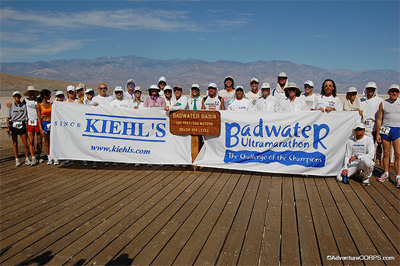
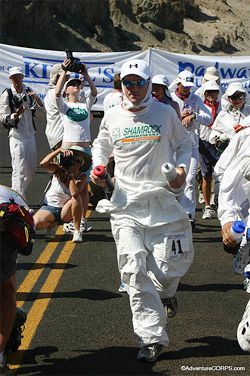 I wore a white long sleeve shirt, running shorts with white Tyvek covering my legs, and a white hat with a bandanna covering my neck to stay protected from the sun. I also covered my face with 50 SPF sun block and protected myself from blisters by spreading Vaseline on the most susceptible areas. The race director Chris Kostman counted down from ten and we were off. I felt very strong at the start and initially did not feel the impact from the heat. We ran for about a mile when I saw the first of the crew people caring for their runner. There were a lot of experienced runners and crews in my wave and it showed early on. This was the first time either myself or any of my crew members had participated in the event and because of that our team got off to a bit of a rough start. We were one of the first to the starting area so our vehicle was blocked by others double parking around us. They had to wait for the others to move out of their way before they could get on the road to begin crewing me. I was a little worried when I saw the other runners being helped out so early on and my crew were nowhere to be found. I figured, though, that if I couldn’t run at least a couple of miles through Death Valley on my own I didn’t deserve to be there in the first place. Things were a little confusing once they caught up with me because instead of pulling up the road a mile they stopped immediately. This kind of start made it very hard to get into a rhythm of meeting me every mile. Finally I told them I was willing to bite the bullet for awhile and I asked them to pull up a mile so we could get in sync. It would also give them time to catch their breath and allow them to prepare properly for my arrival. It was at this point that I realized just how hard of a job crewing was going to be. Imagine having to stop at least 135 times over a two-day period with little time to rest.
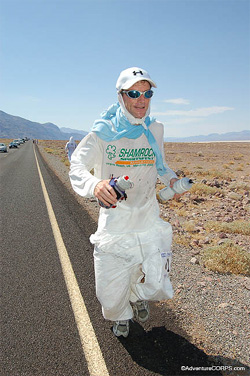 The next major event occurred around mile ten when I started feeling a pain on the side of my left knee. The course was flat to rolling the for the first 17 miles so even though I had a slight ache the pain was manageable except when going down the few hills. I didn’t let it concern me until I hit the last half-mile downhill stretch going into Furnace Creek when the pain in the knee became excruciating. Furnace Creek was designated as the first major checkpoint and an area where civilization existed so I stopped to rest and refuel. I even took a couple of minutes to stand in the air-conditioned General Store where I could get relief from the heat. When I returned to my crew vehicle Don Lundell recognized that I was having trouble with my knee and allowed me to use his massage stick. The pain was localized on the side of the knee, which immediately told me my IT band was inflamed. Despite the localization of the pain I was sure the cause was actually closer to the hip. Instead of focusing only on the knee I massaged the entire leg from the hip down to the knee.
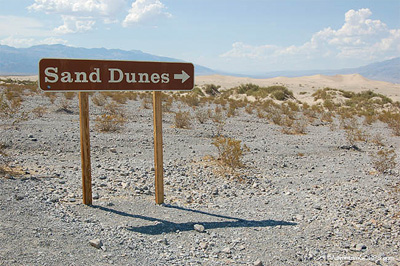 The scenery from miles 17-42 was pretty consistent with what looked like large farmer’s fields on either side of the road, but instead of crops growing the fields were covered with rocks. In the distance, beyond the open fields, beautiful orange colored rocky mountains could be seen. It just didn’t feel real. It felt as though I was caught up in a time warp and I was somewhere I didn’t belong. The course remained flat from mile 17 until about mile 30 when the road gradually started to ascend. I used a run/walk method to get up the hill using the road reflectors as landmarks of where to run and where to walk. I felt good for several miles and still felt confident in my ability to do well. I kept reminding my team that we were in this together and that I needed them to take care of themselves while at the same time taking care of me. I constantly checked to make sure each was eating, drinking and taking salt when needed. They were working so hard and I thought it was important for me to put them at ease. I didn’t want them to worry about me. The knee hurt but I hung in there as I descended the short hill that ended around mile 35.
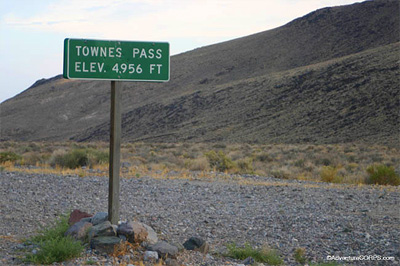 Dori took over the pacing reigns as we made our way up the long climb to Townes Pass. We actually did a lot of running from reflector to reflector because the knee didn’t hurt as much on inclines as it did on descents or flats. I still had a lot of energy and once the sun went down I was able to focus on the beauty of the nighttime sky and the million stars it held. Neither of us astrologers, Dori and I pointed out a couple of constellations that could easily be seen from below. Personally the only formation I could find was the Big Dipper, but with the stars seemingly so close any knowledge at all I should have been able to point out everything the sky held. It was such a perfect night—so peaceful and quiet that I felt at ease even though I knew I had a long journey ahead of me. I never once thought about the work that lay ahead but rather the beauty of the area.
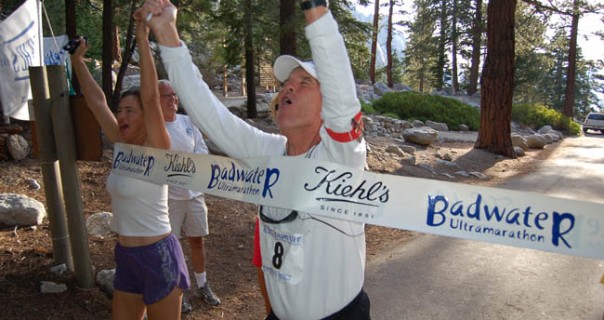
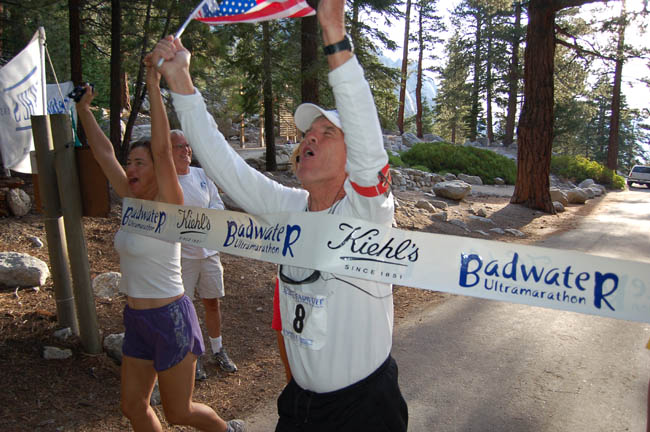
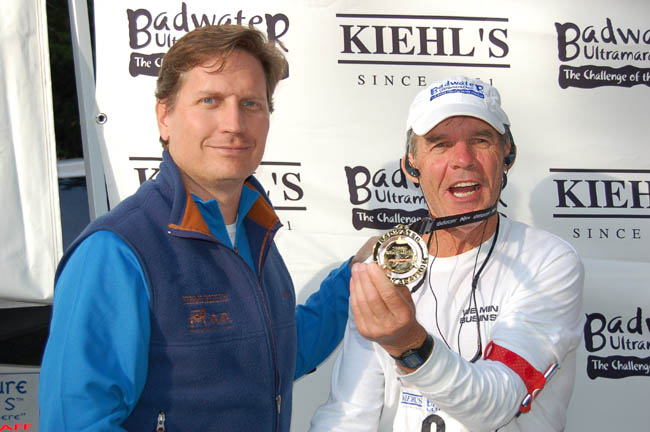
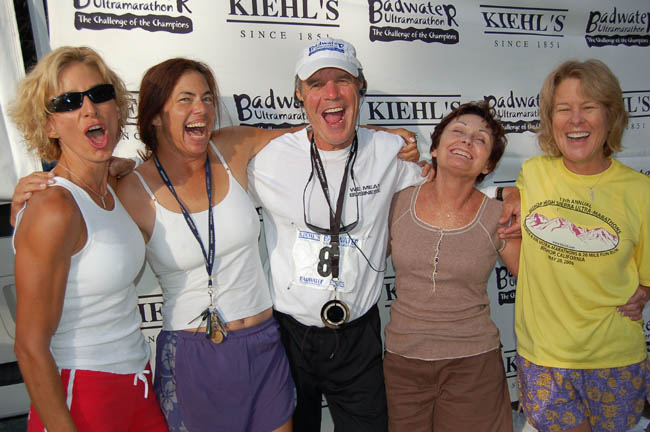
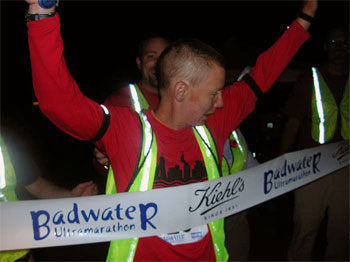
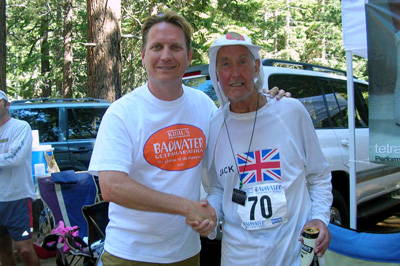
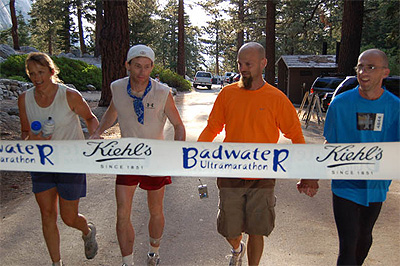 As the sun rose I wanted to turn around and look back down the mountain but I didn’t want to do so until I reached Vista Point where the views would be best. The switchback climbs that took us to this point were the toughest of this 13-mile section. Overall fatigue and the altitude were taking its toll on me. I was motivated to finish strong though, so I continued to push. When I reached Vista Point I only briefly turned to observe the scenery below. It was so amazing to see what I believed to be the entire 135 mile course that I had just traversed over an almost two-day period. I was in awe of what I saw below but I was also ready to finish so I turned back around and continued on. Just as we turned to go up, a vehicle from above slowed and came to a complete stop as the ladies inside cheered me on. The ladies that were cheering were members of Shannon Farrar-Greifer’s crew. They had been so nice to me the entire way and it continued even as I was on my way to finish. I’m certain I blushed in shyness, as I never had so many women make such a fuss over me. Their cheers gave me the energy to move forward up the final hills toward the 1-mile to go marker. Upon reaching this mark Rick and Dori both challenged me to move faster in order to break 45 hours. My mind wasn’t sharp enough at this point to determine if a sub-45 was all that important so I put my trust in Rick and Dori and fell back into the zone that allowed me to get to this point so fast. I swung my arms in dramatic fashion, breathed rhythmically and moved my legs quickly. We reached the one mile to go marker in under eight minutes at which point Dori told me that I didn’t even need and even split to break 45 but I moved faster anyway. I yelled for Rick and Phil to be ready to join us, as I wanted all four of us to cross the finish line together. As I yelled Phil seemed to disappear which upset me enough to yell at Rick to get him back. Rick yelled back that Phil needed to notify the race organizers that we were on our way so they could set up. Satisfied with his response I continued on. We made a left turn onto a paved road that led us into a wooded area where we were joined by the rest of our team. We then crossed the finish line together in a time of 44 hours and 56 minutes, mission accomplished. Once across the line Chris Kostman who placed my finishers medal around my neck greeted me and then posed by my side for a few photos.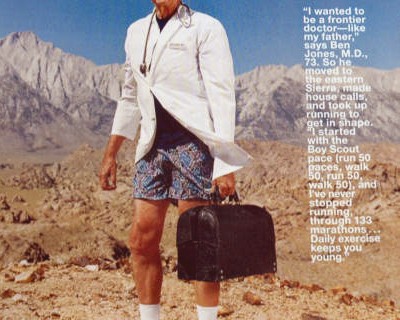
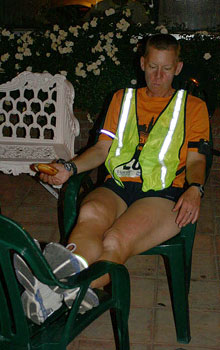 See, I thought I had a rather compelling argument after having run 122 miles from Badwater to Lone Pine in roughly 38 1/2 hours. I was completely out of gas. My legs were leaden, feet swollen, shoulders drooping. The remaining 13 miles (with over 6000 feet of ascent) to the trailhead of Mt Whitney seemed impossible. The physical pain of blistered feet and legs covered in heat rash was nothing compared to the teetering edge of complete muscular exhaustion. I could not imagine taking one more step.
 But I had really done the race on my own, up to this point. I had predicted exactly my arrival times into each of the time check points with amazing accuracy. I was able to eat and drink hardily throughout the race. The scientists who collected my blood and urine throughout the event were amazed at the normalcy of the results. I remember being happy and chipper throughout most of the miles (check details with the crew on this one!). I had executed my own race plan and done it well, until I had drained myself dry.
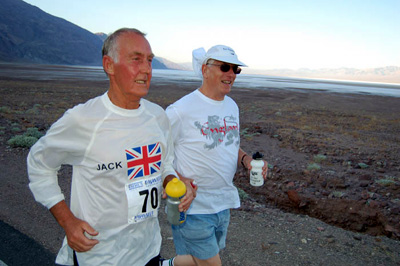
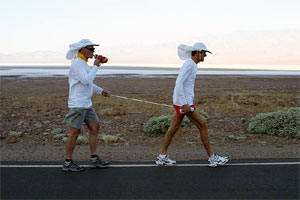 Flip Jurgens, my fellow South African, had committed himself to be my sighted guide/horse for the race and we were hoping to finish the distance within the 48-hour cut-off, thus qualifying for the coveted “buckle.” A sub-60 hour time was needed to be classified as an official finisher. As we trotted along the first 27-kilometre leg to Furnace Creek, the first check point, we were very conscious of what we were trying to do—all very well to plan a sub-48 hour attempt in the comfort of our own homes in South Africa, but no one had warned us about how horrifically high the mountain passes were and the baking heat had really worried me from the minute we stepped down from the jet at Las Vegas! Having read a fair number of the “blood and guts” articles from past races & having had much warning about Death Valley from the leathery veterans whom we met at race registration, we had decided to take the first 65 kilometres through the Mojave Desert very slowly. (As we saw later from the results, we were the last to leave the valley).
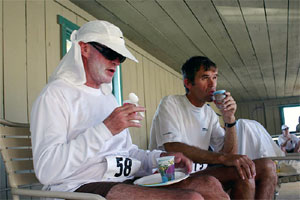 Townes pass was an experience of its own: 27 kilometres of mountain which took us from sea level to over 5000 feet. The hot wind from the desert was still with us for a while, but the temperature gradually dropped and we reached the top in just under six hours. This section was still and dark with but few vehicles at that time of night. Flip kept a good lookout with his headlamp—there is a snake called the sidewinder which comes out onto the road at night!
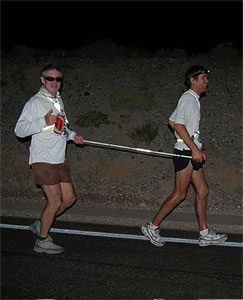 I don’t know why, but we were in a really crazy mood going up Father Crowley’s. We had taken the bit between our teeth to go for our buckles, were feeling great and we pushed it up the mountain as though we only had 20 kilos to go to the finish! While we suspected that we would pay for it later, it didn’t kill our mood—maybe we had mountain sickness! Father Crowley’s came and went during the morning and we were finally able to look down into the last valley: 55 kilometres of long, rolling downhills to another stark salt plain, passing through the tiny village of Lone Pine and then only 20 kilometres after that up Mount Whitney. Flip could see its snow covered peak in the distance: a 14,000 foot beckoning finger high in the sky with our own road winding away into the hot, dusty plain below!
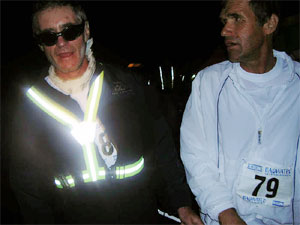 Decision time. Flip had to leave me and go on – he was still strong and could cruise his buckle – no more time left to wait for me to recover. All agreed: Flip went off with Bob and Susanne in one of the vans while Henri, Dan and Patrick stayed with me. Well, without going into too much of a story, we just went very slowly up that last bit. The two-and-a-half hours I took must be my personal worst for eight kilometres! But, hooray, we got the buckle! The clock stood at 46-and-a-half hours when we slowly crossed that finish line at 4.30 in the morning—too tired for even the tears which the moment deserved. Flip was 35 minutes ahead, finishing in 39th position and I made 41st —exactly halfway down—or halfway up—the field of the 81 crazy people who tackled this year’s race.