Category: Arthur Webb

Hall of Fame: Arthur Webb

In 2013, Arthur Webb, a 15-time competitor in the Badwater 135 – who set a personal record and new 70+ Age Group Record during his final appearance at age 70 in 2012 – was inducted into the Badwater Hall of Fame.

His plaque reads:

Arthur Webb is proudly inducted into the Badwater Hall of Fame

in recognition of his fifteen years of devotion to the world’s toughest foot race

July 2013


The Art of Finishing Badwater 135

By Arthur Webb
Fifteen-Time Finisher: 1998 through 2012, including a Personal Record and Age Group Record of 33:45:40 at age 70 at his final Badwater 135 in 2012. His stats.

I completed the 135-mile Badwater Ultramarathon fifteen times (includes one honorable mention). I had five solid years (under forty-hours), but more struggling years when I suffered too much too many times. After two poor consecutive races, I researched my problems, discovered flaws, retooled my training/racing plans, and had two successful almost painless performances, including a 33:45:40 personal and age group course record at age 70 in 2012.

Badwater 135 is daunting and unforgiving. No one escapes the inevitable attrition, and the haunting, excessive heat, fatigue, and weariness. No one. Everyone knows serious challenges will happen even during a “perfect” race. But if you make mistakes, then many major debilitating nasty problems will arise during a long miserable, relentless, grinding march to the finish line – or to a dreaded DNF (Did Not Finish).

However, various issues which impact progress and cause unplanned and excessive downtime can be avoided with proper preparation and execution.

How I Had Problems (you can, too). It is easy (Guaranteed):

The following are various mistakes I have made over the years. As a result, even partial recovery took hours, but it was too late, and I suffered along with my performance and race goals. It only takes one bad move from the list below to make your race very difficult, it not impossible to finish. Having two or more of these issues in one race will only make it worse, if not impossible to finish. I have done or experienced the following at Badwater 135 over the years:

  1. Overtrained: Too many miles. I started the race weary, tired, and vulnerable.
  2. Super hydrated (never, ever works): Too much water (clear urine) before an during the race (if maintained for prolonged hours) will degrade the processing system resulting in ugly issues: severe cramping, weakness, extreme fatigue, nausea, bloating weight gain, and a snail’s pace crappy miserable race. This was my number one nemesis that resulted in many poor performances and still happens to other runners at Badwater and at other ultra-races.
  3. Dehydration: Too little water (bright yellow or darker urine and tenting skin) caused severe cramping, nausea, diarrhea, and nasty downtime.
  4. Nutrition: Consumed too many calories that further bogged down my system causing stomach distress, nausea, lethargy, and unnecessary downtime.
  5. Electrolytes: Too much sodium led to excessive water retention and the super hydration problems above. Too little led to dehydration problems. Consuming a full spectrum electrolyte replacement is critical (not just salt / sodium.)
  6. Heat Issues: When clothing is too dry or not wet enough, core temperature rises and the body is much more vulnerable to excessive heat, exhaustion/stroke, lightheaded, listless, nauseating downtime or worse.
  7. Guessing Game: When I tried different foods and drinks (shot gunning) during the race (which had been not evaluated in training or in previous races), it was a huge mistake.
  8. Rest stops: Too many for too long in a chair, the van, or on the desert floor. There was no rhythm. It was either gear-up into the dreaded restart mode (again…ugh) or gear-down into time-consuming recovery/rest modes (more…ugh).
  9. Mountain goat: Ran up all the hills and/or exceeded race pace. A bad move.
  10. Restaurant cuisine: Dined at a local restaurant (one time). Different food and water caused stomach distress before and during the race. This is an overlooked issue; eat what you are accustomed to before and during the race.

How I avoided these mistakes (you can, too) and set personal and age group course records:

I did ALL of the following. Except for the normal wear and tear, I was comfortable the entire race with none of the nasty debilitating problems above.

  1. Training: From 120-miles a week to 90 for three months. Started fresher, full of energy. Long runs were 15 miles. Last three weeks were all power walking in the hills.
  2. Evaluated everything in training:
  3. Best advice (by far): “Less is Best” and “Top Ten Mistakes to Avoid” by fuel/ nutrition expert/guru Steve Born. I used his advice/formula, and it made a huge, gigantic difference. I believe these are Must Read articles.
  4. Fluids: My intent was to bypass the over/under hydration nasty debilitating toxic water issues. My goal was to remain close to my pre-race optimum running weight (when urine color was light to pale yellow). I would adjust fluid intake if my weight (on a small scale) drifted too much (a few pounds) either way, which was rare. I sipped (guzzling is a form of overloading) on 15 to 20 ounces of ice water (from a 16oz hand-held plastic squeeze bottle) an hour in the heat of the day and less in the cool of night. Let me reiterate: I never, ever taxed my system by overloading with too much water, nutrition, or sodium (Points 4, 5 and 6.) It worked. There were no nasty issues.
  5. Nutrition: I never consumed more than two hundred (all liquid) calories per hour (even less in the extreme heat). I sipped on a thick mix of Perpetuem chased with a splash of water and, at times, Ensure. My back-ups – which I never used – were past race-proven peanut butter, noodle/tomato soups and lean turkey slices (no bulky bread).
  6. Sodium: Two or three Endurolyte capsules an hour during heat of the day (less at night). If I felt even one slight muscle twinge I immediately took more.
  7. Breaks: One planned fifteen-minute leg massage at Father Crowley’s (mile 80) on a yoga mat on the ground and five minutes seeking relief in the parking lot bathroom. No comfortable chair (we did not even bring one) or cot was used. Otherwise, I kept moving.
  8. Sauna and steam room training: This required four intense weeks and one lighter week just before Badwater. Review my “Heat Training in the Sauna” article here at badwater.com (Note: Crew members should also heat train and follow much of the advice in this article.)
  1. Foot care: No tape. I coated socks and shoes with Gold Bond’s foot powder and never had even a hint of a blister, even when my feet were wet.
  2. Course Knowledge: This is priceless. Although I knew every step of the route, during the year, I studied the entire course on Google Earth. I memorized elevation changes, the dips and rises, and all the other nuances. During the race there were no surprises. I was more relaxed and comfortable knowing exactly where I was and what was just ahead.
  3. Mindset: I concentrated on my race pace and assorted goals. I did not let me mind drift or become distracted by external “noise.” I stayed intensely focused on a detailed estimated time of arrival at landmarks, mile markers, and checkpoints. I charted everything in advance, including hourly fluid and calorie intake, which made it easy for the crew to follow and execute.
  4. Pace: I trained and planned for a ten-minute per mile pace to Furnace Creek, then eleven-minute miles to Stovepipe Wells (an added minute to help avoid/sidestep degrading heat and thermal headwind issues in this area. (If I were much younger, or an elite runner and it was cooler, I would have been comfortable running a bit faster to Furnace Creek and Stovepipe Wells). Then I power-walked all the rolling hills and mountains, ran down the backsides of each mountain, and lightly jogged and power-walked all the flat sections.
  5. Pre-race food: I brought my own food and drink and ate my regular diet (there were no surprises). Race day was a small bowl of oatmeal three hours before the start.
  6. Stayed wet: During the heat of the day, my veteran crew (and pacer) kept me wet using a variety of handheld sprayers and sponges, and then at night only if I felt overheated. I carried a small spray bottle of chilly water used to keep my face cool.
  7. Clothing: Everything was light, white, and absorbable. I wore snug arm and leg compression sleeves and kept them wet during the heat. In the wind they were more aero-dynamic and dried out slower than the full coverage white suit that some runners wear. During intense heat I placed a small and large wet towel over my head and shoulders. I never overheated.
  8. Gloves and scoops: Crew used latex gloves and a scoop when handling food and ice. Crud and bacteria grow very quickly in the heat and cause immediate stomach distress.
  9. Stayed grounded and modest: The absolute highest priority at my last Badwater 135 race was to “shoot for the moon” and smash personal and course age group records. Yet, I told everyone my goals were more modest. Without the needless self-inflicted mind-torturing pressure from social or other media, I was always calm, relaxed, and performed as I knew I could – and not as others expected. It worked: Records fell.

That is what I did. It was not easy (it never is) and there was a host of annoying challenges along the way. But chasing personal goals and setting or breaking records is always extremely difficult. Yet it can be accomplished without piling on unnecessary suffering.

Except for a medical emergency, there are zero reasons for any starter not to finish. Be smart, patient, follow proven guidelines, do not trip on egos, and remember when you feel cruddy, sick, or as bad as you have ever felt (and, at times, you will), there are other runners who feel the same or worse but will continue, grind along, and stay the course because there is nothing more rewarding or life altering in the running world then crossing the finish line at Badwater.

Any questions contact me at Runerof100@aol.com or on Facebook.

Life is Grand!

– Arthur Webb (The Grinder)

15 x Badwater Finisher (1998-2012)

Age group (70-79) course record holder 33:45:40 (2012)

Badwater Hall of Fame (2013)

Ultrarunning Magazine: Age group performance of the year (2012)

“Do or do not. There is no try.” – Yoda, “Star Wars”

“Honor and respect the dignity of the Human Spirit. Always finish what you start.” – Arthur Webb

Badwater 135 Revisited: Tips from a 15-time Competitor

By Arthur Webb

I “completed” the 135-mile Badwater Ultramarathon 15 times and earned 14 buckles. At the 2012 Badwater 135 race, at age 70, I set two personal records: A 33:45 finish (by 12 minutes), and a 23:55 at 100 miles (I had never broken 24 hours on this course) and eclipsed the age group record by more than 20 hours.

During those 15 years I tried everything to reach goals. Some things worked and others were complete failures. After 13 years of “experimenting” I finally found the right combinations and it was all worthwhile. We paid strict attention and followed to a “T” the formula listed below, which was the key to peak performances (fewer troubles/problems and pain free) during my last two successful Badwater races.

*I wanted to share this valuable information with first time entrants and/or veterans still looking for a few magic ingredients.

  • Liquids: I weighed at the end of my training regimen, before going to Badwater. That was my target weight. I usually drank more water hanging around Badwater and tended to become “over- or super-hydrated” which was reflected at weigh-in. We used a scale during the race and once the “excess” water was sloughed off and the target weight was reached, we kept it within 2 pounds (high or low). It worked. It’s number one on this list for a reason. In the past too little or too much water (it doesn’t take much) caused way too many nasty problems, which led to diminishing returns and debilitating performance. Thirty ounces or less an hour is more than sufficient for the system to work efficiently. (We charted all food and water intake).
  • Electrolytes: For ten years I used Hammer’s Endurolytes (2 to 8 capsules an hour depending on the heat) and had only a few cramping problems (abated by downing a few more) and zero side effects. They work.
  • Nutrition: One bottle of ice cold Ensure (240 calories) worked better than solid foods, but 240 calories an hour of Hammer’s Perpetuem by far worked the best. More than 240 calories an hour (of anything) will tax the system and performance will suffer.
  • Clothing: White short sleeved wicking shirt, compression shorts and Moeben compression arm and leg sleeves and head scarf (soaked in cold water) was miles ahead of anything else and by far the most comfortable and effective apparel.
  • Power walked: All the bigger hills, especially Towne Pass, Father Crowley, and Mt. Whitney. Paid rich dividends.
  • Stay wet: My crew used an assortment of sprayers and soakers filled with ice water during the heat of the day (on me and themselves), which helped keep core temps near normal. I carried a small 8-10 ounce sprayer filled with ice cold water the entire race and constantly spritzed my head and face and any hot spots. My pacer carried a larger sprayer and wet my clothing, arms, legs and head during the heat of the day. Don’t dry out.
  • Shorten the course: Between Furnace Creek and Lone Pine there are ½ mile markers on the right side of the road (example: mile 110.5, to Lone Pine, across from the Chevron Station at Furnace Creek) and mile markers on the left side of the road (example: mile 110 a half mile past Chevron Station heading north). They were my landmarks. An extremely huge benefit was knowing exactly where I was at all times, which helped maintain focus on pre-race plans, race pace and shortened the Badwater course to mentally pleasing ½ mile segments. It worked. Could easily be number one on this list.
  • Blisters: Lightweight white socks filled with Gold Bond Foot Powder prevented blisters, even when my feet were (soaking) wet. I never tapped my feet. Before the powder routine I simply cut the blisters (some were big and ugly) and kept going. A very minor inconvenience. They all heal eventually.
  • Keep moving: I took a much needed potty break and had a quick leg massage at Father Crowley’s Viewpoint (mile-80) and a few 5-minute or less breaks on the “uncomfortable” stoop of the van. That’s it. I stayed out of the “too” comfortable check-in stations, chairs, and the van. Besides, rest, cold beer and pizza awaited at Whitney Portal.
  • Course knowledge: I had the advantage of knowing all the nuances of the Badwater 135 course, but still spent many hours virtually running and studying the entire route on Google Earth (in street view). I even marked (pinpointed) each mile. It’s a convenient tool and productive mental exercise easily accomplished in the comforts of home.
  • Stay positive, focused and finish: Grumbling and making excuses (remember who signed the entry form) is another self-defeating slippery slope. When the wheels start to come off (and they will; possibly many times) stand tall. Remember there are other runners/walkers/shufflers on the Badwater course that feel just as bad or worse but will fight off all the miserable suffering and manage to finish. Besides not one crew person has ever volunteered their valuable time and energy at Badwater to watch a runner quit.

The trek from Badwater across the Death Valley Basin and over several mountain ranges to the finish line on the flanks of Mt. Whitney is incredibly difficult. It will test you emotionally, physically, mentally and spiritually. Yet, it’s a powerful rewarding experience that’s guaranteed to influence and enrich your life forever.

I do miss it so.

Life is Grand.

“There are those people who say they can. And there are those people who say they can’t. They are both right.”

“Do or not do. There is no try.”   – Yoda, “Star Wars”

Any questions, send me a note: Runerof100 at aol.com

OLYMPUS DIGITAL CAMERA

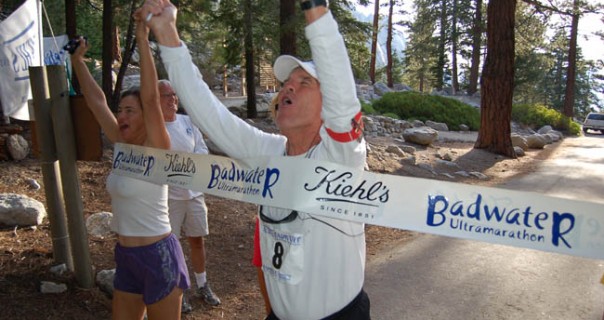
Art Webb at the 2012 finish line, after setting a PR at age 70 and new age group course record.

OLYMPUS DIGITAL CAMERA

Art Webb at the 2012 finish line, after setting a PR at age 70 and new age group course record.


Badwater 135 Survival Tips

I have officially completed the 135-mile Badwater 135 Ultramarathon fourteen times. The following list covers everything that has worked best for me at this race. Some points may also help other runners, crews and pacers spend more time focusing on race goals instead of being distracted by lots of piled-on suffering and unnecessary down time.

1. Physical Training

I run 120-miles a week for three months. Half the mileage is on the flats and half in the hills. I do daily core strengthening and stretching workouts at a fitness center and cross-train with long bike rides. This stamina and confidence boosting training regimen may seem extreme, but so is Badwater or any ultra race.

2. Sauna Training*

After my daily mileage I bake in a 170-degree sauna for up to an hour. The sauna enhances performance by acclimating the body to the extreme 130-degree blast furnace-like desert heat (in cooler ultras it helps ratchet up the comfort level when dealing with our internal heating system) and also prepares the system to process (absorbing and sweating) the large quantities of liquids consumed during the race. This may be the most important tip.

*See the various sauna and heat training articles in the Training & Preparation section at in the Badwater University section here at Badwater.com, especially Arthur’s own article, “Heat Training in a Sauna.”

3. Skin Protection and Cooling*

The sun’s intense heat, the drying winds, and the 200-degree pavement sap exposed body parts – especially the back, hamstrings, quadriceps and calf muscle groups – and your performance will really suffer.

I cover myself with a long sleeved Patagonia white shirt and matching pants, a shrouded hat and sun screen. When it is really hot my crew will soak me with cold water from a garden type sprayer or drape my shoulders with a cold water soaked towel. I carry an 8-ounce spritzer of ice water. The mist I spray on my face and other hot spots is a refreshing coolant.

*See the various “Foot Care and Skin Care” articles in the Training & Preparation section in the Badwater University section here at Badwater.com

4. Feet and Blisters*

Shoes: I usually wear my most comfy shoe the first day and change to another pair with the toe box cut out the second day. I have worn flip-flops for several miles for even more relief.

Socks:  I prefer a light cotton sock filled with Gold Bond foot powder but this year I will try the highly touted Injinji wicking toe sock.

Blisters: Against conventional wisdom, I never tape my feet. For the ugly blistering (that will never stop me), it’s simply cut, drain and go. Besides, they all heal in a few weeks.

*See the various “Foot Care and Skin Care” articles in the Training & Preparation section in the Badwater University section here at Badwater.com

5. “Speed Kills”

Since I am not an elite runner (though they can also crash) my mantra is to run the easy parts easy and power walk the hard parts. This is a difficult proposition, especially as you watch other runners disappear into the horizon, but it is effective. My two best times were a direct result of sticking to this discipline.

6. Support Van Supplies

Contains a large chest filled with dry ice, cubes and blocks (dry ice on the bottom of the chest helps slow down the melting process of the regular ice). The cubes and blocks are used to top off four smaller chests containing liquids of choice and two five-gallon coolers of water for drinking and spraying. If overheated, I will climb inside the large cooler to cool off. Sizzle!

7. Rest Stops

If one paces properly, a ten minute or less respite at the time stations is more than sufficient. Use the time to change shoes, socks, clothing, gorge on liquids and electrolytes and possibly take a short cooling dip in the pool at Furnace Creek, Stovepipe Wells and Lone Pine. Then get going.

8. Beware of the Chair

It is comfy to sit in a chair for long periods, but more than a few minutes is counter-productive. Based on experience I know that lots of time, which can easily amount to hours is wasted (attempting to recover, socializing, eating, etc.) at the check-in stations.

Skip the chair. It takes too many miles to get the body fluid and back up to speed again. It is more advantageous to continue to move forward at a more relaxed pace (amazingly, the body seems to recover faster on the move).

9. “Shortening” the Race Route

I had a tendency to run Badwater from time station to time station, but they are about 20-miles apart. Long desolate and arid stretches of desert in 120/130-degree temperatures was hard to mentally grapple with. Whew! There is nothing worse than concentrating on a time station that is ten-miles in the distance and never seems to get closer.

To chop up the Badwater course into shorter and mentally comforting running zones, I began concentrating on the landmark and other signage that are three to four-miles apart. If I want to shorten the course even more (especially during the second day when I get extremely tired) I use the mile-marked posts or the alternately (on the other side of the highway) marked one half mile posts. Yes, it really, really helps!

10. Music

At times, music soothes the soul and at times it is distracting. Still, a useful tool; wherever I go, my iPod goes.

11. Nutrition

The body can only process about 350-calories an hour. I drink one cold Ensure Plus every hour and an occasional Power Gel or GU. At times Sustained Energy, Perpetuem, peanut butter, soup or turkey slices are used to provide a good change of pace. Liquid meals are best in extreme conditions, because they are digested quickly and the blood used in the process is able to return to the extremities to help cool the body surface.

12. Electrolytes*

To help prevent cramping and dehydration I will take Endurolytes or S!Caps. They contain the proper mix of potassium, sodium and magnesium. In extreme heat I will take the recommended dosage (experiment during training runs). Previously, salt replacement was guesswork and I had incredible cramping episodes. I started using these products at Badwater after about five years and the cramping has stopped. They work.

13. Hydration*

Every few miles I drink 16-ounces of cold Crystal Geyser water, PowerAde or a Starbucks Frappuccino (my preferred drinks). The body can only process about 32-ounces of liquids an hour (maybe a bit more in extreme temperatures, but not much more!) so it is important not to over-hydrate.

To eliminate the water loss or gain guesswork we frequently check my weight using an electronic scale. Your weight the day before the race is a good baseline. Be careful: Starting line weight can be misleading because most runners are already a tad over-hydrated. A constant weight or a few pounds either way is preferred; any more leads to the troubles below.

The following five points are hydration and electrolyte problems (Karl King, Ultrarunning Magazine, 2007) that I have personally experienced. Yuck! Beware! Medical assistance may be required to correct any of these conditions. Finishing the race is probable, but you will be red-lining in the danger zone.

A)    Low on Fluids and Possibly Electrolytes

Symptoms: Plunging weight, lightheaded, shortness of breath, stop and go slower and wobbly pace, urine is yellow and sparse. Hint: Severe dehydration; the worst case scenario.

Solution: Consume liquids immediately. Further deterioration leads to dizzy spells, rust colored urine, fainting and hours of down time, which could lead to the ugly DNF; and will if an IV is used.

***  Immediate indication of dehydration: Squeeze all your toes together for five seconds. If they spring back you are OK. If they stay curled or curl up more you are dehydrating and need to remedy ASAP.

B)    Low on Electrolytes but Fluids are OK

Symptoms: Horrible cramping begins. Wham! They strike incredibly fast and are generally severe. You wind up on the ground curled up like a pretzel. Weight, urine output and color had been okay?  Hint: You need electrolytes.

Solution: Immediately start replacing with S!Caps, Endurolytes, salt tablets, etc. Don’t lay there. Get up and start moving at an easy pace. In less than an hour the sodium level will balance and the cramping will subside. Yeah!

C)    Too Much Water and Electrolytes are OK

Symptoms: The stomach begins to bloat (easy to spot as you begin to look pregnant) and urine output is normal and clear. Weight is up a few pounds and you feel a bit sluggish. Oops, I have gone to the starting line in this condition!

Solution: Correct this very common over-hydration condition by drinking less (until weight is normal). Drinking more fluids may lead to the next problem.

D)    Too Much Water and Low Electrolytes

Symptoms: The stomach looks like a water-filled balloon, there if puffiness in your extremities, your weight is way up, and at times there is excessive clear urination. You are sluggish and performance suffers because you have to stop to water the cactus every five minutes. Hint: You are super-hydrated.

Solution: Boost electrolytes and forget the fluids until your weight is normal. This may take several hours or more!

E)    Too Much Water and High Electrolytes

Symptoms: You look and feel like the Pillsbury doughboy.  Weight is much too high, the stomach is bloated and all the extremities are really swollen. Urine output is clear and sparse. You are sluggish and your performance is suffering dramatically. Hint: You are maxed out with water and sodium.

Solution: Stop fluid and electrolyte intake until you’re weight normalizes, which may take hours or days.

14. Pacers

My top three points if a pacer is used:

  1. “Pace” behind the runner: (Badwater race rule). It’s easier to monitor from behind and it gives the runner a clearer view of any immediate footing or tripping problems on the trail/road.
  2. No unsolicited chatter: Distracts a tired and focused runner.
  3. Aid stations: Get your runner in and out quickly. Prod them. Make sure they drink soups, take electrolytes and don’t get comfy sitting down. Remind them that they will feel better if they continue to move forward. “Time waits for no man.”

15. Crewing*

Ten Badwater helpful hints.

  1. Have several pre-race meetings to cover all the crew responsibilities and contingency plans.
  2. Crew must take turns sleeping/resting. A major objective is to have fresh people, especially during the second day. Crew should appear energized even if you are not. This keeps the runner positive.
  3. Leap-frog the runner in two-mile intervals, give or take, depending on the availability of parking spots, the terrain, the heat, and the runner’s condition.
  4. Attempt to park the support vehicle in the runner’s sight (except on winding mountain passes). A tired runner equates out of sight as not being there or not caring. It is a mental downer and performance really suffers.
  5. Cater to the runner’s needs on the up-slope of a hill. Runners usually run the down hills; no need to stop their momentum.
  6. Make sure runner doesn’t stay in a chair or rest stop too long.  (Unless medically necessary). Keep them moving forward.
  7. Use the scale to weigh and chart the runner’s fluid situation; especially when it is extremely hot. Correct imbalances immediately.
  8. Chart food, liquid and electrolyte intake at preplanned intervals. This should keep the tired runner – who has no ability to remember these details – balanced.
  9. Understand and follow all other race rules.
  10. Bonus points for runner and crew: Laugh and have some fun!

16. The Runner

Please, no groveling or whining. Treat your crew (and race staff) with due respect. They deserve tons of thanks for their volunteered time. A tired and pissed off crewmember / pacer will never enhance your effort. Their responsibility is to pamper and prod you through the event. Your responsibility is to stand tall and silently deal with the pain, misery and suffering and to finish the race. Don’t forget you were the one who filled out the race application.

Good luck to all.

Arthur Webb, Badwater 135 Finisher in 98, 99, 00, 01, 02, 04, 05, 06, 07, 08, 09, 10, 11, and 12

Heat Training in the Sauna

By Arthur Webb
Fifteen-Time Finisher: 1998 through 2012, including a Personal Record and new Age Group Record of 33:45:40 at age 70 at his final Badwater 135 in 2012. His stats.

The heat in Death Valley in July is extreme. The official weather station is located at Furnace Creek where it can reach 130 degrees (54C). But, in micro-climates, like the Stovepipe Wells area, it is always hotter. Since running in suffocating heat on 200 degree (93C) pavement presents health and safety issues, health officials and the race staff strongly recommend that all runners do some type of heat training. I rate its importance in the race survival equation equal to, and possibly greater than race pacing, food, and fluid intake.

Check the Badwater University section of this website for other heat-related articles and tips. Any single method or any combination of them will help you acclimate and contribute to a successful trek across Death Valley. For example:

A). Train in the desert (any desert) as presented by Doctor Ben Jones.

B). Simulate heat conditions by running in layers of clothing as suggested by Stephen Simmons.

C) Bake Yourself: Drive around with the windows rolled up and the heater on high. When time and availability was a problem, I used this method during my ½ hour drive home from work. It can get messy, but it does work.

D). Follow my Sauna Training plan outlined here, a key factor during fifteen Badwater finishes:

  1. The sauna serves two extremely essential functions: First, it prepares the body to deal with the blistering heat in Death Valley. Secondly, according to medical research, a runner acclimated to the heat loses fifty per cent less sweat and sodium.
  2. Train every day: Although you may have to take a day off to hydrate or rest, a daily blast works best. Dry saunas simulate Death Valley conditions, but if a steam sauna is available use it, at least, one day a week. Sometimes storms lash the Badwater area, and it becomes extremely hot and humid. Fortunately, I have rotated between dry and steam saunas and have been ready for anything. It was effective.
  3. The goal is to stay in the heat of the sauna for as long as possible: When I rigorously workout in the sauna I must leave it too soon, which defeats the purpose (Remember, at Badwater, you are in sauna-like heat all day with no doors to escape). I have better results sitting on the planks doing a light abdominal workout. I save my harder workout for the daily run, which I do first and then use the hot box. Running after a sauna session is extremely difficult. Save this time for hydrating.
  • Note: There are athletes that have favorable results using treadmills and stationary bikes inside the sauna. (The extremely elevated heart rate is a concern and may stress the body too much; what’s mainly necessary is heat adaptation, which can be done without exercise).
  • Also Note: Dr. Lisa Stranc-Bliss has had success (Women’s winner Badwater 2007) using an infrared sauna, which she says, “the lower temperatures penetrate deeper….and she can stay in much longer in the 130–145-degree range.”
  1. Be patient: Most saunas top out at the 160–180-degree range (71-82C). The first few days are the hardest and hottest. After fifteen minutes it becomes overbearing, and it is time to leave. But as time goes by you will be able to stay in longer. By the fourth week, you should be able to manage 30 minutes or more at 180 degrees (82C). I use the sauna at a more relaxed level throughout the year, which helps me ease into the extensive four-week regimen listed below.
  2. Drink: It is important to hydrate while inside the sauna.
  • Note: I usually take in three 2-liter bottles of ice water. One bottle is for replacing liquids copiously sweated out and two bottles are for rinsing the body (acts as a coolant for a minute or so), and together they help you stay in the sauna longer.
  1. Electrolyte Replacement: I take Endurolytes while in the sauna. (Choose your favorite sodium replacement, but make sure it has a proper balance of all electrolytes, not simply sodium; Ultra Salt by Pure Vitamin Club is also very popular.) Include taking them during your daily runs as well. They restore the potassium, magnesium and sodium that depletes through sweat. I would not run Badwater without them. They keep the system balanced and help prevent nasty cramping issues. They do work.
  2. Time element: Finding enough sauna time may be a problem because of all the training (and working). Anyway, weeks before the Badwater race everyone has run more than enough mileage, so skip a run or two and just bake in the box. Besides, as the race draws near, heat training becomes much more important.
  1. Recovery: After the sauna I lay on a bench for about ten minutes as the body continues to sweat. After the elevated heart rate returns to normal levels, it is time for a cool shower and an evening of hydrating. Liquid intake is essential to help keep urine color at optimum race day running levels (light to pale yellow).

   ***** Important note: I typically ran (and other runners, too) my daily training miles with urine color either in the yellower under saturated levels, and, at times, in the clear urine over saturated levels and rarely noticed a drop in performance. But, running Badwater or any ultra at these red-lining toxic levels for prolonged periods of time (without adjusting water intake) is a one-way guaranteed ticket to a major problems. For greater insight read my article “The Art of Finishing Badwater 135.”

  1. Heat training in the sauna should take no more than four weeks and usually three are sufficient: When you get unexpected goose bumps at work/home or when it is one hundred degrees (38C) but feels like eighty (27C), you are acclimated. It is best to stop sauna training at least three days before the race. Do not worry; it takes weeks to lose the saunas heat benefits. The last days before are the time to hydrate properly (including electrolytes; don’t make the mistake of drinking excess plain water before – or during – the race.)

10.  Sample four-week sauna training:

Day
Minutes
in Sauna
Temperature
01
15
160F / 71C
02
15
160F / 71C
03
15
160F / 71C
04
15
160F / 71C
05
20
160F / 71C
06
20
160F / 71C
07
20
110 / 43C (steam)
08
25
160F / 71C
09
25
160F / 71C
10
25
110F / 43C (steam)
11
25
160F / 71C
12
30
160F / 71C
13
30
160F / 71C
14
30
160F / 71C
15
35
160F / 71C
16
35
160F / 71C
17
40
160F / 71C
18
40
160F / 71C
19
40
160F / 71C
20
30
110F / 43C (steam)
21
45
160F / 71C
22
30
170F / 77C
23
40
170F / 77C
24
45
170F / 77C
25
30
180F / 82C
26
35
110F / 43C (steam)
27
40
180F / 82C
28
45
180F / 82C

11. Race Day: Wear white shrouded hat and light-colored wicking clothes (white arm and leg sleeves are a bonus). And keep the clothing wet. We use a super-soaker (water gun) and/or large handheld squirt bottles filled with chilly water. I always carry a small (4 oz) squirt bottle filled with icy water that I spray on my face to help cool and refresh (it works). If clothing dries out it may protect you from ultra-violet rays, but they tend to retain heat and you will start overcooking.

That’s my Sauna Training Plan, along with other heat training options. Regardless of the schedule or method you select, any heat training will make running Badwater 135 more tolerable.

Hopefully everyone will complete this incredible race, because crossing the finish line at Badwater 135 is as good as it gets.

Best of luck to all.

Life is Grand

– Arthur Webb (The Grinder)

15 x Badwater Finisher: 1998, 99, 00, 01, 02, 03*, 04, 05, 06, 07, 08, 09, 10, 11, 12

* Honorable mention

Age group (70-79) course record holder 33:45:40 (2012)

Badwater Hall of Fame (2013)

Any questions:  Runerof100@aol.com or find me on Facebook.

Romancing the Stone

A 2007 Badwater race story

I am at the starting line and in a few minutes will be joining the six and eight o’clock runners who are already well into the march of madness across Death Valley and two mountain ranges and then to the finish line, at the Portals, halfway up MT Whitney. We are at the 135-mile Badwater Ultramarathon. It is the toughest footrace in the world.

Although I am here, it was questionable a week ago. Excruciating back pain from a mean-spirited and jagged-edged kidney stone had me digging in my heels and white knuckling the rails of a gurney in an emergency room. A dose of morphine gave me temporary relief but during the week there was more pain as gravity continued to drag the cruddy little thing through my plumbing system. It is quiet now; knock on wood.

My goal is to be the first runner over sixty (I am 65) to ever-complete Badwater in less than forty-hours. For months, I averaged 120-miles a week and everyday baked in a 170-degree sauna. I am physically ready.

I have run this race nine consecutive times and have created a race plan, which incorporates everything that has worked on this course. I am mentally prepared.

My support crew, Christine Webb, Julie Strong and Alfonso Partida have met a dozen times to cover possible contingencies. They are ready.

Our support van contains a large chest filled with dry ice, cubes and blocks. This is used to top off four smaller chests containing liquids of choice and two five-gallon coolers of water for drinking and spraying. If overheated, I will climb inside the large chest to cool off. Sizzle!

I will down one cold Ensure Plus every hour and an occasional Power Gel or GU. Every few miles I will hydrate with 16-ounces of cold Crystal Geyser water, PowerAde or a Starbucks Frappuccino (my preferred drinks). I will only carry an eight ounce spritzer of ice water. The mist I spray on my face and other hot spots is a refreshing coolant.

Since I only drink a thimble full on my daily runs, I have not over-hydrated. This will help avoid the numerous nasty water polluted health issues, which includes waddling down the road feeling sluggish and bloated. To eliminate any guesswork we use an electronic scale, which allows us to immediately adjust my hydration level and to help prevent cramping and dehydration I will take Endurolytes.

It is 105-degrees, humid and windy. To prevent moisture loss, I wear a long-sleeved Patagonia Capilene white shirt, matching pants and a shrouded hat. When it is really hot my crew, who will leapfrog me in the support van for the entire race, will soak me with cold water from a garden type sprayer.

Race director Chris Kostman gives the countdown and off we go. The last thing I want is to get caught up in a jackrabbit start; egad, after a few minutes, I am dead last.

I have modified Tim Twietmeyer’s (five-time Western States 100-mile endurance race winner), “I run the hard parts easy and the easy parts hard,” to Arthur Webb’s mantra, “I will run the easy parts easy and power walk the hard parts.” There will be no exceptions. Well, okay, maybe a few.

The early miles along the edge of this pure white salt basin is a music laden iPod sing-along and endorphin filled run. At the Furnace Creek Hotel (mile-17) I jump into the pool for five minutes to cool down. It’s twenty-five miles to the next time station and it would be a mental handicap heading into the next marathon of arid rolling hills and extreme temperatures, overheated. After filling my shoes with Gold Bond blister preventing foot powder, I am quickly back on the course.

We have a second vehicle that my wife uses to help crew for the next two hours and then drive to a hotel to rest.  A major objective is to keep the crew fresh, especially during the second day.

The seven race time stations that are about twenty-miles apart are too much to grapple with. To compress the 135-miles into bite size comfortable mental running zones, I concentrate on the landmark and turnoff signage spaced every three to four miles. As weariness creeps in, I will shorten that distance by using the highway marked mile-posts and on the opposite side of the road, the alternating one-half mile-posts.

As I handily run across the barren heat filled and unforgiving landscape, I catch a runner who is sitting on a mound of sand. He says, “I am cramping and my pacer is looking for my crew.” He has no water, appears dehydrated and is overheated. His crew is too far ahead, has few supplies and is puzzled. What! How can this happen? I tell them, “He can stay in the hunt if he is cooled down and given lots of water and electrolytes (my wife gave them a full bottle).” It is too early to be suffering so much. I hope he makes it.

Nestled between the sculptured sand dunes and the multicolored segmented chiseled mountains is the Stovepipe Wells Resort (mile-42). The white metallic roof of this next time station shimmers in the distance and looks like a Star Wars movie outpost: desolate and eerie. Maybe aliens in the spacecraft that I have seen hovering in this area during previous Badwater races think so too.

The seven-miles that cross the Death Valley basin are mostly downhill and are usually run in oppressive, suffocating 130-degree furnace-like heat. But as I run past the Devils Corn Field and into Stovepipe Wells it is a comfortable and less punishing 120-degrees. Thumbs up for heat training.

After a splash in the small tepid pool, a Slippery Rock University research vampire team doing a volunteer study on dehydration drains a sample of blood. Since it will be dark soon, I strap red flashers on my arms and legs and begin to charge up the 16-mile mountain pass that has always been a monumental struggle.

Nine miles into this teeth gritting effort, I am concerned about a sharp twinge in my lower back. Terrific! The last thing I need is the kidney stone to rear its ugly head and curl me up on the ground with knife stabbing pain. Maybe it is just teasing me since it settles down after a few miles. Hopefully, the pounding on the pavement has either jolted it free or the liquids have washed it into my disposal system. Splash! Adios.

At his memorial in June, I promised family and friends that I would dedicate this Badwater race in honor of ultra running giant, friend and crewperson, Vincent Pedroia, who had just crossed his last finish line. This is swirling about in my head as I move straight up the pass into the billions of stars. Fortunately, Julie is walking with me because my heart is in my throat and I need her to lean on.

At the top of Townes Pass (58-miles) I am washed with fatigue. As I lay on the ground for a short respite and a leg massage, will be the only time during Badwater that I momentarily question “what am I doing here?” Yuck, scratch that negative thought. After a failed catnap, I am still fresh enough to run the downhill miles and surprised to pass about a dozen runners who are walking this section.

Near the bottom the winding road straightens and I see about fifteen crew vehicles strung out across the desert floor. The caravan of flashing red taillights energize me enough to handily finish this grade and trek across the salt basin and up the three-mile incline to the Panamint Springs Resort (mile-72).

I chat with volunteers, Mags and Jack Denness (eleven-time Badwater finisher), as the van is filled with gas. I am always toast here and require a long break, but this morning moving forward has a higher priority. Shortly, I start up the eight-mile steep winding hill to Father Crowley’s (mile-80). I will not take another break for fifty-miles.

Chris Frost “zips” by me and says, “Arthur you have a very good thirty-seven hour race going for you.” I lightly brush it aside. It is too early to be thinking about finishing times. Besides I am still doing my three-mile at a time chunk thing.

Although the stark beauty in this area captivates and inspires, it remains a difficult climb. I have run this section in two hours but was totally drained. Today, I will walk at a two and a half-hour clip and after cresting have enough energy to keep on moving.

It is early morning as my wife returns full of energy and relieves the tired crew. We will do the same things that worked yesterday and hopefully it will be deja vous all over again.

The next ten-miles of rolling hills are sprinkled with sagebrush, sparse yucca trees, dinosaur flashbacks and 110-degree heat. To feel at ease with the extreme fatigue that is assaulting me, I gear down into a one mile at a time mode.

At the Darwin checkpoint (mile-90) it’s a hello, goodbye and keep on trucking. The next ten miles along the Centennial Flats are mostly downhill and before it gets super hot, I want to take full advantage.

I believe the halfway mark in a 100-mile race is about mile eighty. At Badwater it’s the large white cross and gravesite at mile ninety-six. It is noon and hot and I am struggling.

At the one hundred-mile marker, we clip a water soaked white towel over my shoulders and I am cooler. I see the weather-beaten trailer park burg of Keeler on the edge of the dried out Owens Lake bed, eight miles in the distance. Burdened by the heavy towel, I am still able to run to its front doorstep, where I run out of gas. Sputter! Sputter!

While my wife power walks with me for the next nine miles, swirling winds filled with sand and extreme heat blow across the road and thrash us. Whoa! Not only is it difficult to breathe clean air, but this battering is taking its toll. As weariness sinks deeper into my body, it is now Badwater one half mile at a time.

Howie Stern, from Mammoth Lakes, CA arrives and relieves my wife. After shuffling into Lone Pine (mile-122) I ease my overheated body into the Dow Villa hotel pool. Minutes later after gorging on turkey slices and Starbucks doubleshots, I grudgingly begin the extremely steep final thirteen mile climb.

The first few miles up the Whitney Portal Road are punishing as strong headwinds make it tough to advance. Howie leads the way and is figuratively dragging me up the mountain. The pace picks-up as we realize that the end is near and there is a sense of urgency to polish this thing off. It’s analogous to the cows smelling the barn thing. Moo!

Just below the two long switchbacks we know that if we charge the last five miles a sub thirty-eight hour finish is possible. But, I am struggling with bone marrow penetrating fatigue, strained hamstrings, and a painful sciatica exacerbated by a chronic lumbar disc problem. Great!

I have a few fleeting doubts as Howie says to me, “Art, whether you crawl or surge either way it’s going to be painful.” He is right. So I tell him, “Okay let’s go for it; besides it will be over sooner.”

In the past I have been visited by Yetis, Pterodactyls and other strange creatures in this area, but not tonight. Without the distracting “hallucinations” the switchbacks seem brutally longer and it has become extremely difficult to push forward.

With a mile to go and time slipping away at warp speed, it would be easy to ratchet down to a less taxing one step at a time survivor shuffle. Instead, I dial up the worn but still motivating “Pain is temporary. Pride is forever.” cliché and continue to press on.

At last, with only a few turns to go, this seemingly endless chore is almost over. My crew joins me and we cross the finish line holding hands, screaming and hollering. We have a mini celebration for the 37:48:35 finish. Yes! We did it. And it sure feels good.

I usually get very emotional at the finish. But, I have reserved it for tomorrow’s MT Whitney summit, when I will write in the logbook attached to the side of the cabin, a respectful farewell to my fallen friend.

Later after everyone is in bed and I soak in a whirlpool to begin the long recovery process, I realize that I owe this memorable finish to my crew for their relentless, unwavering and successful race management. Yeah team!

Thanks to race director Chris Kostman, his AdventureCorps crew and all the volunteers for staging this spectacular event.

Thanks to Heidi and Cameron Steele, Carmen Kaplan, SCORE International, Barbie and Jim Riley for their support and the smiley face poster I taped to the back of the van, which gave me a buzz for two days.

Thanks for the motivational drawings that I had taped to the side of the van from the youngsters that I ran for at the Valley of the Moon Children’s Home in Santa Rosa, CA. Hopefully, the inspiration is mutual.

Thanks to nurse Kelly Ridgway and all my friends for looking over my shoulder and nudging me on the web cast. I knew you were there. Whew!  Paybacks are tough.

Thanks that the kidney stone I nursed for a week was never a major factor and hopefully it is now a permanent resident somewhere on the desert floor.

Congratulations to the “Mayor and First Lady of Badwater” Ben and Denise Jones for their induction into the Badwater Hall of Fame. Yeah.

Congratulations to race winners Valmir Nunes and Lisa Bliss. Hurray!

Thanks to protégé’s Julie Strong, Alfonso Partida and Howie Stern for their unselfish and stalwart help. It’s your turn now.

To Trisha, family, friends, Sassy and all the other animals in his charge, it was an honor to “carry the torch,” and a montage of memories taped to the van, at Badwater and to the MT Whitney peak, in memoriam, for the beloved Vincent Gerard Pedroia. Amen.

And finally a huge thanks and much more to my beautiful wife, Christine, for everything. Next year during the Badwater race we will take a dip in the pool, but in Hawaii. Oops! Maybe?

That’s ten Badwater’s down and (?) to go.

It was a privilege to be part of the 2007 Badwater Ultramarathon.

Arthur Webb

Badwater Finisher

98, 99, 00, 01, 02, 03*, 04, 05, 06, 07

*Honorable mention

IMG_2601

DSC02319

The Grinder

Eight time finisher, including 2006
DSC_0044

We are parked just below the sea level sign that is perched high above on the jagged side of a cliff in this Amargosa Mountain Range. As I anxiously sit in the stuffy van, beads of sweat stream down my face as an unusual dose of humidity settles into the area. It’s nine-fifteen in the morning and already a stifling 110-degrees.

In forty-five minutes, thirty-one runners will begin the 135-mile journey through Death Valley and traverse two long mountain passes before finishing at the Portals (8600-feet), halfway up MT Whitney. During the race air temperatures will reach 130-degrees and the pavement will be a toasty 200-degrees. This is the Kiehl’s Badwater Ultramarathon and is billed as the toughest footrace in the world.

As other runners caravan in for the start, I begin to fidget and fuss. Although I am mentally and physically prepared for the enormous challenge ahead, I question everything. Did I do enough heat training? Did I run enough in the hills or on the flats?  Since I am super hydrated, why I am cotton-mouthed and thirsty? Worry wart!

Just before ten o’clock, all the runners are having group pictures taken by the lacquered wooden marker with yellow lettering, noting that this is the Badwater Basin; at two-hundred and eighty-two feet below sea level, it is the lowest point in the Western Hemisphere.

As the National Anthem plays, I wonder, what I am doing in this group of incredibly talented athletes. Scott Jurek, Pam Reed, Ferg Hawk, Monica Scholz, Dean Karnazes, and Charlie Engle are here. They have all finished Badwater in less than thirty-hours. Egad!

After the word is given to start this momentous task, I immediately slip to the back of the pack. At 64-years, I am the oldest and slowest. This will not be a tortoise and hare story because I will never deliberately catch any of these runners. My goal is to use course knowledge, a ton of experience and a truck full of tenacity to make it to the finish line. I hope they don’t consume all the pizza and cold beer before I get there.

My crew, three beautiful ladies from Bishop, CA, Debbie Masters, Diane Spieth and Kari Marchant along with my wife Christine, the prettiest of all, will do yeoman’s work by leap-frogging me in the Enterprise rental van and, at times, will pace for me. They will pamper me the entire race.

In order to keep me relatively cool in the scorching heat, they will wrap iced-bandannas around my neck and spray cold water on my light colored safari hat and long-sleeved white Capsilene shirt.

Once every hour, I will snack on a bottle of Ensure or a mix of Hammer’s Perpetuem, chased with a big gulp of Crystal Geyser water, Crystal Light, PowerAde, or a Starbucks Frappacinno. Every twenty minutes, during the heat of the day, I will swallow a couple of Endurolytes (sodium, magnesium and potassium replacement capsules that help ward off dehydration and cramping.) That’s it. Yum!

Although there is absolutely no guarantee of finishing this monster and the next two days will dole out a pinch of misery, pain and a splash of pleasure, it is a privilege to be here. This will be my ninth consecutive Badwater Race.

As I run along Highway 178 on the edge of Death Valley’s sprawling salt basin, which appears to be filled with water as the pure white dried out surface shimmers from the undulating heat, the anticipation, apprehension and jitters begin to fade away as endorphins start flowing through my system.

After a few miles a minor problem has developed. My left foot, which was rubbed with Hydropel (a gel that is advertised to prevent blisters) and not enough foot powder, is sliding in the shoe (blisters are caused by this rubbing friction). Hopefully it will soon settle down. Clomp, slide, clomp.

It takes three and a half hours to run to the Furnace Creek Resort checkpoint station (mile-17). Jack Denness (clipboard check-in man and eleven-time Badwater finisher) tells me, “You have to go back to the start because of a rule infraction.” I think he is kidding me; at least I hope so. I sit on the stoop of the van for a few minutes and place a different pair of shoes and socks over my water soaked and shriveled feet that reveal early signs of ugly blistering.

Ten minutes later I set off for Stovepipe Wells (mile-42). Although there is beauty in the basin and on the colorful stratus of the surrounding hillsides, the searing and intense heat makes this portion of the race a monumental chore. It is almost a marathon in distance as it meanders through the arid desolation in Death Valley.

This year I have strategically broken it down into smaller sections. By focusing on several landmarks, (about four miles apart), Cow Creek, another lowest elevation sign, the Beatty turnoff and Salt Creek, my intent is to cover this part of the race with less stress. It works. By the time the race turns west at the Scotty’s Castle exit (mile-35), I am more relaxed and less tired than usual.

While I run between the incredibly sculptured Sand Dunes to the north and the Devils Cornfield (a sea of crystallized salt clumps) to the south, the wind begins to blow sand and extreme heat across the basin. It never really changes through here. Every year, as if on cue, it gets windy and the suffocating 130-degree blast furnace-like heat stings my face and scorches my lungs.

As I hunker down and run the next seven-miles across the valley, I encounter a major problem, but it is not mine. Something is very wrong because I have caught Pam Reed (two-time Badwater race winner) who is barely shuffling along. “Since the start of the race I have had problems with fluid intake and I think I am severely dehydrated,” Pam says. For health concerns her race will be over in a few miles. It’s sad and I feel bad for her. Unfortunately, even the best athletes have their off days.

With patriotic spinning pinwheels and an American flag flapping in the super-heated breeze, Debbie, Kari and I run yelling and screaming into the Stovepipe Wells check-in station. At nine-hours and thirty-minutes, I am right on schedule.

I forego the small hotel pool that is filled with overheated-runners and their crew. Instead, in a room we have reserved, gingerly step-into the tub for a quick cold shower, but, like a cruel joke, both taps are hot? Before jamming my shoes back on, numerous large blisters on both heels and several toes are sliced open. I use no tape; it’s just cut, drain and get back on the road. Ugh!

Except for a few moments that Kari walks with me, the next seventeen-mile steep trek to Townes Pass (mile-59) is a lonely six hour power-walking struggle. In the past I have ran and alternately walked, but it has been extremely exhausting and, at the top, there was little left in my tank.

As the sun sinks behind the mountains, the intense heat begins to dissipate. Although it is cooler, my body is still under enormous stress as I chug forward. Dehydration is always a major concern and fluid intake, even at night, continues to be a top priority.

To ward off cars and other scary things I wear red flashers on my arms and legs. I also carry a small flashlight, but it’s almost not needed. Billions of stars have lit up the evening sky and comets, meteors, shooting stars and spaceships are streaking everywhere. Although the going is tough, I am fortunate to be here; and, jazzed to see the universe in the raw. Man, this is good stuff. Just before cresting the mountain a ten minute respite, on a lawn chair, is needed.

My favorite part of this race is running down the nine-mile western slope of Townes Pass to the eastern edge of the Panamint Valley Salt Flats (mile-68). In the cool of the evening, I pass Vista Point where you can see MT Whitney about seventy-miles away. Near the bottom, I catch Shannon Farar-Griefer and her pacer who ironically lives only a few miles from me in Northern California.

Along the salt flats, just four-miles from Panamint Springs, I catch Jack Menard who is creeping along and babbling to himself. Jack swears, “I see a bear walking in the scrubby brush.” I tell him, “Bears don’t live out here.” Maybe he has spotted the baby dinosaur that I saw, a few years ago, prowling in the area. Whatever it is, he will have something to mumble to as I forge ahead. In another mile I catch Lisa Smith-Batchen who is struggling and tells me, “I have been nauseous for hours from some horrid stomach problem.”

No one escapes. If you run Badwater something along the way will likely sink its nasty hooks into you. It might be throwing up, cramping, dehydration, heat illness, mental or emotional fatigue or a myriad of other possibilities.

This race is a gut check and it will test you in every possible way. If you are mentally strong and can handle lots of suffering and pain, it’s possible to recover enough to move ahead. Forget the prerace,”The best laid plans of Mice and Men” idea, and put them in the shredder. I don’t know about the front-runners, but for the rest of us getting to the finish line is a constant process of red-lining and overcoming numerous bad episodes. Period.

I am getting extremely fatigued and the last three-miles into Panamint Springs (mile-72) are laborious and slow. Both feet are screaming for relief from the severe blistering. So, I ditch my running shoes for black rubber thong sandals. My reward is the shattering realization that dawn has arrived and not only am I facing a steep eight-mile climb to Father Crowley Vista Point (mile-80), but also another hot day of struggle. Yikes!

I catch Mike Sweeney and David Bursler at the beginning of the climb. One of their crew members is amazed that this is my ninth Badwater and is surprised even more when he sees me trekking up the mountain in sandals. He turns to me and says, “Art, you just grind these things out, don’t you?”

“Yes,” I tell him, “That’s exactly what I do.” For two days I totally zone in on my objective, improvise as needed and keep moving forward. I just grind it out. Perfect, after all these years I have a label that fits. I am the “Grinder of Badwater.”

A few miles later the sandals are not working. They are wet and my feet are slipping out of them sideways. The toe strap is slicing deep into the skin, at the joint, on the bottom of my right toe. “Oops,” I tell my crew, “That was a bad idea.” I try walking barefoot but the asphalt is too hot and my feet literally begin to sizzle and cook. So sans socks it’s back into the painful but bearable running shoes.

As the “wheels are coming off,” the sheer beauty in Death Valley gives me a much needed emotional lift. About a mile from the top, the swath of road below appears to have been carved out by a large snake that had slithered across the iridescent Panamint Salt Flats and through the surrounding brown hued mountain passes. The panoramic view of this vast expanse is breathtaking. The best part is that I have already trekked it.

At the top during another change of shoes and more blister draining, a newly-wed tourist couple saunters over to our van. They are aghast and shake their heads at how many times I have completed this race. Oh well, they just don’t understand! But, that’s okay, because no one else does either.

For the next few miles the road winds along the base of a small mountain outcropping and empties into the Darwin Flats. Sprinkled amongst the sagebrush are weather beaten Yucca trees. Although they provide only a slice of shade, I imagine that all the animal life in this area are nestling at the base of these prickly covered scarecrows. It always amazes me how anything can survive in this oven-baked desert.

Debbie then Diane walks with me during this portion. After the road crests over a rather long knoll, I start to run again. I pass the Death Valley National Park Boundary Sign (mile-85) and cross five-miles of rolling hilly terrain before walking the last few feet into the Darwin turnoff check-in station (mile-90).

Suddenly, I hear the unmistakable roar of jet engines slicing through the morning sky. The noise is loud and almost deafening. “There, look, right up there,” I shout, while jumping up and down. A powder blue F-16 is flying sideways and only a few feet over our heads. Within seconds the pilot tipped his wing, banked to the north and was gone. I have no idea if he was greeting us or simply practicing his strafing technique, but it doesn’t matter. This show was almost worth the price of admission.

Reenergized, I feel I can run the Centennial Flats; the next ten-miles of gradually rolling downhill’s. All goes well until just before the large white cross (mile-96). Although it’s at least twenty-degrees cooler than yesterday and I am still being soaked with cold water, my body begins to overheat. According to the law of diminishing returns, as the body temperature rises, performance suffers. Well, duh!

Just a minute ago I was running okay, but now I have to climb into the van, lie down and cool off. With iced down towels draped on my head and shoulders and Debbie tagging along for moral support, I am soon back on the road. Since I still suffer from some classic heat stress symptoms my condition is tenuous at best, and there are still thirty-nine miles to go. Yuck!

The next eight-miles of running are more of a shuffle-walk. I have another heat episode (mile-104) and have to get into the van again. To cool down, I sit in a bucket of ice water. Then I dip my head into a brain-freezing ice and water filled chest until the back of my eyes feel like they are being clubbed with a hammer. A pounding headache that feels like it is going to explode will bother me for an hour. To give my crunched feet some relief the toe box in my shoes are cut out. Even though I feel pulverized, I continue to shuffle towards the metropolis of Keeler (mile-108), population 98.

Just ahead, ominous thunderheads roll in from the Eastern Sierras and blankets the Owens Valley. Booming thunder fills the darkened sky and crackling lightning crashes into the nearby hillsides. Actually, getting zapped might feel good. Unfortunately, we are on the edge of the heavy rain, and only a few sprinkles splash the roadway. A soaking in a downpour may cool me off, but as we push forward the rolling storm moves away. Drat! There is some minor flash flooding in the area and rumor has it, “The rains have chased the sidewinders onto the road.” Great!

Just before stopping in front of Keeler to ice-down and gorge on a meal of Ensure, an invigorated Shannon and my mountain climbing buddy Bob Haugh, who have been playing cat-and-mouse all day, pass me for the last time.

Doctor Ben Jones, the “Mayor of Badwater” and roving race magician, stops to take a few pictures (I assume cover shots for Men’s Health, GQ or Vogue magazines), gives us a warm greeting and then drives away. I get a short-lived boost knowing that Ben was not too concerned about my condition. So, I must be okay. At least I am vertical. In past races Ben has found me lying in the dirt along this course suffering from dehydration, cramping and other cruddy things.

The brackish pools of water in the area smell musty and pungent and we are attacked by a huge swarm of mosquitoes. As we hurriedly move forward, I blurt out, “Why would anyone live in this bug infested burg?”

In the past I have run the next twelve-miles into Lone Pine, but not this year. As it gets dark, it should be cooler and easier, but it is not. The wet towel routine is no longer working. In this same location last year, I was also unable to run and I can’t figure out why?  Maybe its age related, or maybe it’s a coincidence, or just maybe after two days of strenuous effort the dial on my gas gauge is simply hovering deep into the red.

The last five-miles into Lone Pine is probably the worst I have ever felt on this Badwater course. The listless, nauseating and washed out feeling is like dealing with a horrid hangover or suffering from the ravages of an insidious flu bug. While I run on one or two cylinders, my kiln-dried mind is on the rack having its perseverance checked. I tell my crew, “I may crumple into a ball on the side of the road or have to go into town and cool off in a pool.” Instead, I bite the bullet and carry on the torturous battle to forge ahead. Whoa! “What price Glory?”

I do a “survival shuffle” into Lone Pine (mile-122) and head for the Dow Villa Motel pool. I gradually place my feet into the water and immediately fall backwards and throw up all over the deck. Then I ease into the cool water and start convulsing and shivering. Burr!  Race medic David Bliss tells me, “This is a normal reaction as the body attempts to balance itself.”

Thirty-minutes later, feeling as “balanced and normal” as I possibly can, I put shoes and socks onto my blistered hamburger-like feet, and begin the thirteen-mile steep climb to the finish line at the MT Whitney Portals. It’s three o’clock in the morning.

Howie Stern, a running friend, walks with me for an hour before he has to leave to go to work. Now it’s me and the music-laden iPod that’s strapped on my arm; so, I start singing and power-walking. It’s hard to believe, but less than an hour ago I was spent and totally exhausted. Now I am spunky and for the next hour sashay up the mountain.

In the dark, a few miles from entering several long switchbacks, I get weary again. My biggest concern is whether I will be safe from all the strange figures that are fading in and out of the bushes along the roadside. I tell myself, “Be calm and relax,” although panic is not far behind. Next time I will bring a can of dog repellant. As the sun rises they disappear, and I continue to gulp down Ensure and Frappacinno’s to help ward off exhaustion.

Every runner who finishes this race in less than forty-eight hours is awarded a coveted Badwater belt buckle. My tired and frazzled mind is making a million miscalculations about the estimated completion time. My crew tells me to, “Stop worrying and quit whining, you still have plenty of time.”  I am so close to the end, yet, still not convinced.

At last, I make the right hand turn into the first switchback (mile-131). With the “end in sight,” I figure it should only take about an hour from here.

At the tree lined entrance to the park, with one mile to go, I see the postcard view of the majestic Mt Whitney. Unless something catastrophic happens like walking off one of the steep cliffs, or carted away by the bears foraging for snacks in the parking lot just ahead, it finally sinks in that I am going to make it.

This gargantuan task is almost over. It’s ironic that after two days of self inflicted punishment and an elevated heart rate that is distinctively thumping against my chest wall, I feel strong and wired. “I don’t know,” yelling to my crew, “Maybe its endorphins or the gallon of caffeine that’s finally kicking-in.”

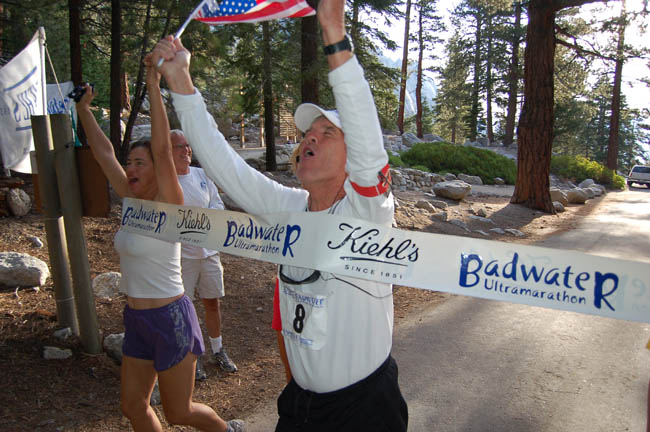
It really gets emotional and I start celebrating by cranking up Led Zeppelin’s, “Stairway to Heaven.” I hold the Stars and Stripes up high, and to prove that you can have some fun at Badwater, “cry out” in victory.

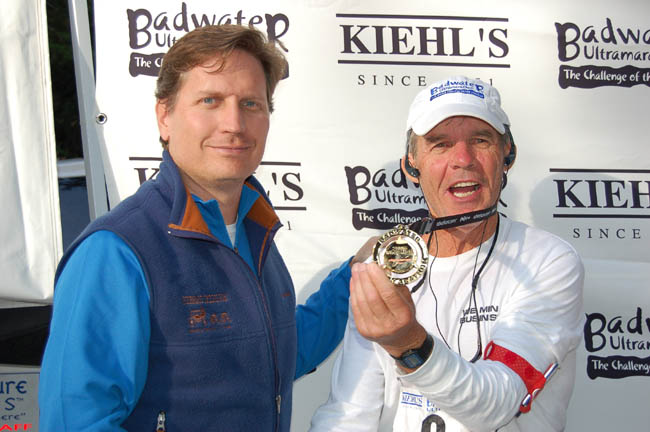
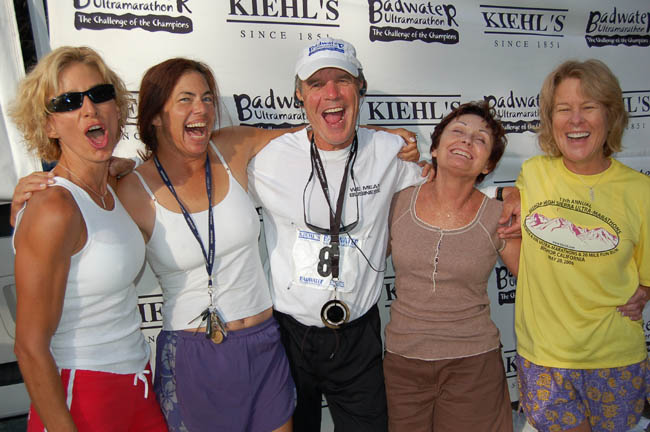
With only a few short turns to go, my crew trots down to meet me. We are giddy and making lots of noise all the way to the finish line. Hurray for all of us; we did it! The time gets a bit slower each year, but at 45:07:21, I will take it. And, I have a little secret confession to make, finishing Badwater keeps getting better and better.

As we begin our trip home, it’s difficult to leave the last six days behind. Especially, the camaraderie, the incredible Badwater journey filled with pain and pleasure and the sheer beauty that is in Death Valley.

This morning, for icing on the cake, I had a reunion with the kids that I ran for at the Valley of the Moon Children’s Home in Santa Rosa, CA. There was some beaming and a bit of pride in their classroom. It was fun rehashing the race, showing some video and answering their great questions.

My ultimate goal is to plant a seed with these kids with the message, that no matter how tough things seem to be at the moment, if you work extremely hard at the goals of your choice and never, ever give up, the respect and confidence that follows will have a major positive influence on you and all the people you touch.

Last year a young teenager came to me and said he had already run away from this (wonderful) facility twice, but now he was going to stay because of what I had accomplished. That stopped me almost dead in my tracks; like a dart to the heart.

People ask me, “Why do you run this race?”

Well, maybe it’s the tremendous satisfaction from overcoming all the adversity, maybe it’s the pain, maybe it’s the challenge, maybe it’s the finish line, maybe it’s the buckle, maybe it’s….… But, to have made such a positive impact in the life of a kid, who struggles each day far more than what we will ever encounter in the desert, is the most special reason of all.

Thanks to race director Chris Kostman, his AdventureCORPS crew and all the volunteers who have made Badwater a top notch race.

Thanks to the ubiquitous Dr. Lisa Bliss, the entire medical staff and the ambulance crew patrolling the area, ready to assist. But, they always seemed to be dogging me like a buzzard ready for its next meal? Easy prey, I guess!

Thanks to all the crews for helping the runners fulfill their dreams.

Kudos and high fives to the runners, and, especially, to those who struggled across the desert but did not make it. The recognition at the awards ceremony for their effort was a real class act.

Congratulations to Lisa Smith-Batchen and John Radich on their successful 300-mile Badwater doubles. Wow! I thought I was tough.

I believe my buddy, Jason Hunter, “Somewhere over the Rainbow,” whose energizing spirit was the secret weapon I had in my hip pocket, would have been proud.

Finally, thanks to Christine, my Rock of Gibraltar wife of 38-years, for steering me in the right direction. Although she has heard it many times before, I believe that next year will be my last Badwater race. Anyone want to buy a bridge?

It was an honor to be a part of the 2006 Kiehl’s Badwater Ultramarathon.

Arthur Webb

Badwater Finisher: 98, 99, 00, 01, 02, 04, 05, 06

“There are those people who say they can and those people who say they can’t. They are both right.”
– Author Unknown
DSC_0051 DSC_0052


See You on the Mountaintop

A Badwater 2004 Race Story

Badwater Finisher, 98, 99, 00, 01, 02, 04

Originally published in Marathon & Beyond Magazine, July 2005

Except for the glimmer of a thousand stars and the faint glow from a few porch lights, the desert outside my room where I am pacing is almost pitch black. It is two o’clock in the morning. A hand full of ravens flit and scratch on the ground near the parked cars. There is noise off in the distance from some animal life digging through the trash cans and the air conditioners drone and hum away in an attempt to keep the warm desert air from the rooms at the Stovepipe Wells Hotel. Otherwise it is quiet.

As I concentrate on the enormous challenge ahead my mind and nerves ramp up as adrenaline, excitement and anticipation slowly starts to drip into my system. The body finally realizes that in just a few hours it will be running the 135-mile race that begins at Badwater, California, the lowest spot in the United States, and snakes through Death Valley and over two mountain ranges before finishing at the Portals halfway up Mt. Whitney. This footrace is considered the toughest in the world. There will be no more sleep tonight and probably for the next few days.

Although I have been here many times, this year is more special. At the pre-race meeting yesterday and at his eulogy in January, I honored my fallen friend, Jason Hunter, before his family, his friends and many great athletes. I dedicated this race as well as the traditional eleven-mile climb to the top of MT Whitney that follows it, in Jason’s name. I am sure that he will be out here, at least in spirit, for guidance and inspiration and to help me fulfill this tall order. I have but one goal now and that is to finish. There are no other options.

In the minutes before the ten o’clock start, I mingle and socialize with the other runners aside the Badwater sign and the Kiehl’s Sponsorship Banner draped across the road were the race begins. I notice that the Sea Level sign that was missing last year is again attached and perched 282 feet above our heads on the rugged side of the Black Mountains. All is well. The National Anthem is played in our honor and hundreds of photographs are taken just seconds before the starting countdown to this grueling event. It is good to be back. This will be my seventh consecutive Badwater Race.

During the first twenty five-miles, while I am still fresh and the endorphins stream through my system, I run and joke with some of the other runners. There is Chris Frost who gives me a Lance Armstrong yellow charity wristband, prompting the joke that we are engaged again. I wonder if his fiancée, Tracey, knows about this?  And Lisa Stranc-Bliss, the running Doctor, who pronounced me alive enough to continue on during a bad spell in last year’s race. Want to feel humble? Run a few miles with everyone’s favorite and ultrarunning legend, Marshall Ulrich.

We run north along the great sprawling salt basin with its colorful landmarks reminding us that we are indeed in Death Valley. The Timbisha Shoshone Indians call it “Land on Fire”.  We pass by Dante’s View, Coffin Point, Devil’s Wheat Field, Furnace Creek, Salty Creek, Devil’s Golf Course, the Sand Dunes and Stovepipe Wells. The land is picturesque but inhospitable. Left unattended, one could die out here in just a few minutes.

My van is filled with tons of supplies and my crew; Christine (my wife), Vince Pedroia, Juli Dell’Era and John Rodger will be alongside me the entire race. They will attempt to keep me fed, hydrated and cooled off by using squirt guns and sprayers. The van itself looks like a rolling billboard with messages, memorial banners and inspirational drawings from special children taped on both sides. We have another vehicle at Stovepipe Wells to be used to shuttle into town for rest, supplies, Snicker bars and other emergencies.

Around the thirty-mile mark I comment that it is unusually cool, maybe only 115-degrees. But that’s about to change; someone hears my big mouth and begins to stoke it up a few notches. By the Beatty turnoff (mile-35) where the race turns to the west, it is at least 125-degrees. Headwinds generated somewhere in the canyons, pick up the radiated heat from the pavement and are superheated even more as they sweep furiously across the Death Valley basin.

For the next seven-miles the suffocating winds are incessant, and it feels like its 140-degrees or more. It’s like opening a furnace door and standing in front of it with a fan blowing the heat on you. The mouth and eyes dry out, unprotected skin burns, the nasal passages and lungs sting, and it becomes hard to breathe. The cooling body sweat and the water sprayed on the running clothes evaporate immediately, and my core temperature rises as intense heat presses heavily against every cell. Fortunately the months of training in a 180-degree sauna have prepared me for this. I handily move ahead, although the heat will take its toll later tonight.

At Stovepipe Wells (mile-42) I could take a quick break. In the past I have cooled off in the small pool, which is now filled with runners and crews, or I’ve used the shower to rinse the heat away but not this year. I have found that the body starts to shutdown once it stops to relax for more than ten-minutes. I have suffered severe cramping and have witnessed convulsions and techni-colored barfathons by other runners in this pool area. Since this has a tendency to ruin your day, my plan is to continue to go forward and take short respites on the stoop of the van every few hours. So, I just sneak on by.

Then I face the most difficult part of the Badwater Race: the seemingly never-ending sixteen-mile 4900-foot climb to Townes Pass (mile-58). The first few miles are directly into the sun and the hot winds continue to blow. As the sun sets, Chris Frost catches me. When we reach the Emigrant Campground halfway up, we take our first mini break. Kari Marchant, a live-wire crewmember, joins us and we gradually move up the mountain now dimly lit by a half moon and the Milky Way.  We pass the time by laughing at raunchy jokes. I have to tell all of them, because they didn’t know any.

At the top, next to the radiator tank, we take another short break. The wheels are beginning to come off and the tired body wants to lie down. This race has become serious. The weariness that is clinging to the body is similar to tying on a spare tire and dragging it to the finish line. Chris naps while I cool off my legs with iced towels and gorge on peanut butter, PowerAde and Ensure.

We then run other eight-miles, down the backside of the pass to the edge of the salt flats in the Panamint Valley. Looking across this five-mile basin and into the distant hills, we can see a string of a dozen or more muted red flickering brake lights. My emotions lift knowing that I am in the middle of other runners and their crews who are also struggling along this course in order to realize their goals. Misery loves company. As soon as we catch a runner, Chris tags along and they move ahead into the night. I am alone again

Suddenly, on the side of the road, there is a quick and blurred movement. I turn and catch a glimpse of a coyote, maybe more, scrounging around in the bush. The one closest is gaunt, wiry, skittish, nervously pacing and panting. Scrawny and undernourished, it salivates from hunger pangs. I immediately flash on Harry, the protagonist in Ernest Hemingway’s “The Snows of Kilimanjaro”, who lies on a cot in the African savannah dying from the gangrene that has invaded a cut in his leg. Hemingway writes, “… it occurred to him that…he was going to die…and…the hyena slipped slightly along the edge of it”.

Oops! I make some noise and flash my lights towards these guys and they slink away into the scrub. But I sense that they are still close by: dug in, crouched, waiting, peering, hungry and ready to strike for their next meal. I know that I am rank and it must be wafting in their direction. Hopefully they have targeted a smaller morsel in the area. I decide to hurry up before they drag me off into the desert.

Fortunately dawn is approaching and the coyotes and other animal life will soon vanish into the sand in this sparse desert. They will attempt to survive another day somewhere buried, hidden and protected from the brutal heat of the scorching sun. And we runners think that this Badwater Race is tough. For a moment I contemplate their difficult lives: if they manage to survive during the hostile summer then we should be able to handle a few days.

I run to the Panamint Springs Resort (mile-72) looking forward to a short break. I have been active with minimal rest since the start of the race. My overworked, strained and taxed body is fighting back. It needs to be rejuvenated, and it wants it to happen right now. A ten-minute respite turns into forty-five as an unsuccessful catnap is attempted. Then, in another survival moment, I step inside the hotels bathroom/septic system for relief. Whew! Yet, there is even a richer prize than basking in all this glory. Anyone finishing this race in less than forty-eight hours is awarded a cherished and coveted brass belt buckle.

After gobbling down a cup full of freshly made scrambled eggs and chasing them with a Starbucks Frappuccino, it is time to run up another steep eight-mile winding pass to Father Crowley’s (mile-80). The views along the way are breathtaking. The multi-colored canyon walls that spill into the salt flats below are incredibly beautiful.  These huge chasms are routinely used as military training grounds for the F-16’s that swoop down deep inside after their imaginary prey.

My crew is finally able to make cell phone contact with a hometown radio station. After I broadcast my progress report, the host asks me if I have seen my shrink lately. Well, yes I have, but obviously it isn’t working. I just hope the kids that I run for are listening.

At the top it is time for a change of shoes. One sock is soaked in blood and the other is glued to a severe blistering problem and will hamper my effort as the race wears on.

The next ten-miles of gradual rolling hills is brushed in purple and yellow hues and dotted by old abandoned silver mines that probably dead-end into shattered dreams. The landscape is filled with the colors and scents of sage and withered yucca.

A huge rock and dirt formation near the Death Valley Park entrance sign (mile-85) is shaped in the formation of a Stegosaurus. It has several rows of bony plates along its back, so maybe it is one, partially buried, camouflaged and sleeping. Two years ago during the night I saw them crawling across the desert floor. There are times during this race when the demons stir about somewhere within the dark corners of the tired mind and it begins to hallucinate and sees strange things. But, I know that the dinosaurs I saw were real and I suspect that they are still out there, somewhere on the move, despite evidence that they are extinct.

It is early morning and the headwinds return like a giant heat-searing hair dryer. A chronic Achilles problem is flaring up and progress becomes more of a run-hobble. At the Darwin turnoff (mile-90) the race bends north and I will attempt to run the next fifteen-miles that are mostly downhill. The winds that are now at my back help to push me along.

At mile ninety-seven a minor problem has developed. We are out of ice, low on water and the drinks are warm and hard to swallow. Right on time, Nancy Shura from the medical team stops and gives us all her leftover ice and water. Ironically, a similar scene occurred last year when Monica Scholz stopped along the Panamint Salt Flats and replenished my depleted supplies.

At the 100-mile mark high up in the mouth of the pass, I can finally see the great sprawling Owens Valley. But, three-miles later, I can’t run anymore. The hot tailwinds have cooked my hamstrings and they are now misfiring.  We ice them down and I wear long pants in a feeble attempt to keep them cooler. But the damage has been done: they will not respond to this tinkering and I struggle five-miles into the weather-beaten trailer-park burg of Keeler (mile-108).

After a short rest I still feel drained and wilted from the battering of intense heat over the last two days. For the third time in the last five-years the winds are blowing sand and ash from fires in the Sierras across the arid and desolate Owens Lake and into our path. As I gag and choke on the smoke I resolve to plod along until the sun sets behind the mountains and then hopefully run into Lone Pine. My wife and Juli drive into town in order to rest for the final climb.

Once I start running I feel much better. But just a few miles later, I need water and my van is nowhere in sight. Although it is now dark, it is still hot and I begin to overheat. Unable to continue I wait and waver on the side of the road for about thirty-minutes until the van finally shows up: John had stayed behind to make sandwiches in preparation for the final climb. He should have gone ahead to stay in touch and maintain a sense of timing, but, that’s okay. The heat has tortured everyone and understandably a misjudgment was made.

I shuffle the last four-miles into Lone Pine (mile-122), where I rest and cool down at the hotel. The air conditioner gives me goosebumps and my crew believes I am suffering from heat stroke. They call a race medic, who determines the real problem: that it was time to get going and finish this thing off before anything else went wrong.

Shortly, we start up again. Even though Vince and I laugh most of the way, the steep and relentless thirteen-mile climb to the finish at the Portals (mile-135) is pain-stakingly slow. I need to leave something in my tank for after the race, because I still have to climb to the top of MT Whitney. During a weary moment a massive pack of large rats at the side of the road sweeps towards me. Startled for a few seconds, I move over to our van while Vince protects me from the “varmints”. He tells me that I had likely just flashed on some grass that was growing through the cracks in the roadbed. I am not so sure and hurriedly move forward.

With four-miles to go we enter the first of the two-long switchbacks and realize that the end is only an hour away. The pace quickens, there is more spring in the step and now a renewed sense of urgency to polish this Badwater off.

My crew will walk with me the last mile. Everyone is more alive, giddy and spirited, except for nearby campers who yell from their tents to shut up so they can sleep. Sorry, but fat chance. With only a few bends in the road to go the physical and mental demands step aside. As they begin resting on the back burners, I start tripping on my emotions.

With our hands held high and a great whoop we cross the finish line together. Each year that I break the tape a great sense of achievement and pride flushes my system. It is the successful culmination of months of training and a few days of intense hard work over this extremely challenging course. Badwater will never get old. Finishing this race in 43-hours and 28-minutes with my beautiful wife and crew by my side is as good as it will ever get.

Later, sitting alone and relaxed on a bench in front of the hotel, I reflect on what I had accomplished the past few days:

Although I had survived several mini disasters, days of extreme heat and cold, drying winds, the ever-present Achilles tendonitis, severe blistering, vertigo, and incredible weariness, I never at any time ever thought about quitting. I hope that this will set a positive example and inspiration for all the children.

I was fortunate to have run, walked and shuffled, along with many of my friends, through Death Valley and up Mount Whitney. There are very few places on earth that equal in grace and majesty.

I finished Badwater and summated Mt. Whitney for my friend, Jason, a satisfying tribute to his incredible life. It just really feels good that I did what I had to do.

And finally, I will soon be going back home into the “real world” with restored confidence and convinced that if you can do Badwater, you can do anything.

Thanks to Badwater Race Director, Chris Kostman, and all the people from AdventureCorps. There would be no Badwater Race without their effort. It was also comforting to see the emergency vehicles, the medical teams and all the race personnel cruising around and monitoring for any problems.

Thanks to Kiehl’s for their title sponsorship and all the skin care products.

Thanks to Injinji for the socks touted to prevent blisters. Maybe I should have worn them. Well, duh!

Thanks to Hammer-Gel for the Endurolytes. These things work great. Now, can you make a pill to prevent aged related aches and pains? Better hurry.

Kudos to Dean Karnazes, Ferg Hawke and Monica Scholz. Breaking 30-hours on this course is a major achievement.

To every crewmember and especially mine, thank you for your sacrifices.  It could not have been done without your help.

Thanks to nurse Nancy Shura for stopping to help just in time.

Thanks to Marshall Ulrich, the consummate gentleman, for everything. But don’t forget Heather next year.

Congratulations to Lisa Stranc-Bliss for her incredible 37-hour finish and then the MT Whitney summit. It is amazing that Lisa and others have figured out this Badwater Race on their initial attempt. Heck, I have been experimenting out here for seven-years and still manage to screw it up.

Congratulations to Chris Frost for his fine effort. Each year he has a better finishing time and I know why: he has all my good stuff.  Last year he stole my best super-soaker. This year he not only ripped off one of my new hand held spritzers but he also ate all my premium turkey slices. For awhile I thought that he had hijacked my van with the rest of my secret supplies and even kidnapped my wife. The engagement is off and next year I am bringing a security guard.

Most of all thanks to my wife who has put up with this kind of insanity for 36 years. Everyone appreciates all her hard work, sincerity and compassion, but not as much as I do.

It was a privilege to be a part of the 2004 Kiehl’s Badwater Ultramarathon.

I can’t wait until next year.

I will be back.

The Last Lone Runner

2003 honorable mention finisher

Large boulders are strewn everywhere and rivers of mud and rocks are flowing down the canyons and across the roadbed as flashfloods generated from the remnants of a tropical storm have thrashed parts of Death Valley. Especially hit hard on the Saturday afternoon blitz is the area around Townes Pass and the Panamint Salt Flats, which may have been an ominous indicator of more trouble that would hamper my journey only days away.

On Sunday, as our van inched down the steep Echo Summit area above Lake Tahoe, we were hammered for 15-minutes by a thunderstorm filled with powerful winds, rain and marble-sized hail. Not only was there the fear of the front windshield imploding from the vicious pelting, but also the threat of being swept off the hillside and down the steep ravines by the treacherous winds. Is there a message here?

There was definitely some concern, as we were on our way to compete in my sixth consecutive 135-mile Badwater Ultramarathon. This footrace, which is considered the toughest single stage competitive event in the world, starts in the middle of Death Valley, at Badwater, and runs across two mountain ranges before finishing at the Portals, halfway up MT Whitney. To win a prized belt buckle it must be completed in less than two days.

After safely reaching our destination in the desert on Monday, we had some fun and laughs at the pre-race meeting in the Furnace Creek Auditorium. After a comical speech by Ben Jones and race director Chris Kostman covering all the ground rules, the building began to get stuffy and rather warm. As the runners congregated for group pictures on the overheated stage, it was even hard to breathe. I had to leave the building and go outside where it was 120-degrees, in order to cool off. I am not sure but I believe that I was supposed to have ended my sauna training last Friday.

When I stepped outside my room at the Stovepipe Wells Hotel at 5:00 am, I immediately knew that it was going to be a very special and daunting day. Although the sky was clear, it was humid and extremely hot. I could already see heat undulating in front of the magnificently sculptured Sand Dunes just across the street. The tape that was holding the inspirational messages to the side of our van was beginning to peel off. The black ravens, which have somehow mysteriously survived in this harsh environment, were panting and listing on the ground in the shade of the sparse salt cedar trees. They had no energy to fly to their normal resting and baking spots in the trees lining the complex and along the telephone wires that are strung between the poles and attached to some of the buildings. That’s probably not a very good sign. Even the six and eight o’clock starters would have no early morning relief.

For safety concerns, there are three staggered starting times to help prevent the seventy-six runners from bunching up along busy Highways 178 and190.

It was now a sweltering 110-degrees as I mingled with all the runners and their crews at the Badwater sign just minutes before the 10:00 am start. Although it was hotter than usual, my major concern was the missing sea level sign that had always been prominently attached to the craggily side of the Black Mountains, 280 feet above our heads. It was gone. I thought someone had stolen the landmark. It was hard to believe that even out here in the middle of nowhere theft runs rampant.

I will have a word with the Mayor of Badwater, Ben Jones, and possibly First Lady, Denise Jones. Maybe they are slipping. Taking it too easy. Living the good life. Let it be known that another California recall may be in order. Maybe I will challenge him with my campaign platform, “No more crime at Badwater and no more sacred cows”. All I need is two or three votes. With a Badwater population of zero we will probably have to stuff the ballot box in order to pull this thing off. A few million dollars in campaign funding should help do the job. Send lots of money. Cash only, please.

Just seconds before the starting countdown, as the National Anthem is played to honor all the runners, I am a bit concerned about the dried out feeling on my lips and inside my mouth. This is usually an early dehydration symptom. Impossible. I have to be waterlogged from the constant drinking over the last two days. Maybe it’s just a side affect from the humidity or simply nervous energy. Just in case, I drink two more bottles of water just before the gun goes off. Slosh, slosh, slosh.

The 17-miles to Furnace Creek are euphoric, as the endorphins kick in and I run and chat with lots of different people. Want to have some fun? Run thirty-five miles with Chris Frost. He will make it interesting and you will definitely stay loose. Not only did we joke around but we also appreciated the incredible beauty of the desert basin and the magnificence of the colorful mountains surrounding us. It is one of the main reasons why we are out here. In retrospect I should have stayed with Chris the entire way.

Actually everything was going rather well. The heat was not bothering me, too much, even as it began to climb into the 130-degree range. It was still bearable. I had sauna trained for months and was fully acclimated. Besides, my crew, Roman, Jason and my beautiful wife, Christine, who are alongside me the entire race in the van, were attempting to keep me cool by spraying me with super-soakers or draping my shoulders with wet iced-down towels.

I arrived at Stovepipe Wells (42-miles) in decent shape by gorging on plenty of water, electrolytes and eating a variety of high calorie nutrients. For a general cool off and refresher I made an attempt to rinse myself off in the shower by the pool. Gads! I almost scalded myself from all the hot water flowing out of the cold tap. The searing heat of the day even made the water in the pool, the railings and the deck too hot. No relief here.

After a brief respite and a bit of socializing with a few runners and their crews, I started the gargantuan task of climbing the 17-mile grade towards Townes Pass (59-miles). Without exception this area has always been the hottest part of the race. It was now over 130-degrees and the winds coming down the pass made it feel as if I was in a firestorm. The heat was incessant, ferocious and almost intolerable. It kept bearing down on me and there was no escape. Even the 170-degree sauna I had trained in was not this suffocating.

As I began the climb, I started the walk four minutes and then run four minutes routine. It has been the key to my success, on this part of the course, the last few years. I was feeling strong and all my body systems were working properly. So far so good. As darkness began to settle in, I was also looking forward to the cool of the evening. Unfortunately that was never going to happen.

At the Emigrant Station (50-Miles), I decided to take a short break. As soon as I sat on the stoop of the van and had a sip of O’Doul’s, the lights went out. It all happened in a nanosecond. While I was away the Grim Reaper visited me. Although I felt like I was already in hell, unless we were heading for heaven, I wasn’t ready to go. I still had this race to finish. When I woke from dreaming or from wherever I had been, I was screaming, yelling and clawing. A crewmember that was holding me up was receiving the brunt of my blows. Actually, for a few moments, I thought I was gone.

My crew immediately laid me on the ground with my feet up. Once they found my pulse and I realized that I was still alive, I felt okay. But only for a few moments, because soon everything began to spiral downhill. During the next half-hour I threw up and had bouts of diarrhea. Over the next five hours my crew and several medics tried to take good care of me and used everything in the book to help me recover. They administered a mix of ice, cold drinks, wet towels, food and encouragement. Yet, to no avail. I had a similar problem in the past but was able to start again after an hour. Not this time. Something nasty had its hooks in me and was not about to let go.

Although it was not very easy to watch, Lisa Smith passed by yelling for me to get off my butt and get going. My crew thought it best for me to wait and be patient a little longer. Though I tried to resist, because I did not want to waste precious time, I stayed put. I was still feeling terrible. Marshall Ulrich, who was having his own problems, soon stopped by showing some concern. I figured I could tag along with him and somehow muddle through. I struggled with him for an hour and a half and then I could go no further. My tank was on empty. I have never felt so bad anywhere or at anytime. It reminded me of an extremely bad flu episode.

We drove back to Stovepipe Wells looking for relief. The hotel looked like a triage center. Runners were being attended to everywhere. I refused an IV because there were only a few left and others were more in need. Besides, getting fluids from a needle in your arm disqualifies you, and I still had every intention of finishing this race. A bed was available in one of the rooms where other runners were sprawled out, but it was hotter in the room than outside. It was four in the morning and it still had to be at least 110-degrees. It was time to get out of here. It was too depressing.

We headed for Lone Pine where we had another room. Even though I was able to cool off at the Dow Villa Hotel, my body was never really ready to extend itself. Half a dozen times during the day we either started back or drove the 67-miles to move my marker forward, but with little success. The heat was scaring me and I would get weak and nauseous anytime I started to run or walk. Things were not looking very optimistic.

Although sleep deprived and completely washed out, I could not rest or settle down and I kept tossing and slashing about in bed. All attempts at recovering were futile. It was becoming more and more evident that I was not going to be able to finish this Badwater Race. Depressing. After many months of intensive training, I thought I could handle anything. Nope. What went wrong? Maybe it was severe dehydration, or the heat, or some bug, or the law of averages that finally got me. Although I don’t know what really happened, I do know that this had become a major nightmare.

Did Not Finish. A piercing, devastating and crushing blow. A sword to the heart. Three little ugly words. Demoralizing. After twenty-five years of running hundreds of races, I was about to earn my own personal albatross, a DNF. It’s not really what I had in mind, but maybe I could hang a big red flashing neon sign around my neck. Perhaps “Scarlet Letters” emblazoned on my chest. Humbling.

I needed to make something positive happen and soon. So, early Thursday morning, still fatigued and mentally depressed, I began to trudge up Mt Whitney. After faltering for the first four or five miles, I began to feel a little better as I went through the switchbacks near the top and it began to get cooler. I was in awe and completely mesmerized by the stark beauty on this climb, especially on the trail along the Pinnacles on the West Side of the mountain. If you are looking for inspiration it can be found here.

On the peak, while sitting on the rock beside the summit plaque, inclimate weather moved across the area. For ten minutes cold wind, rain and lightning lashed the mountainside and I began to freeze and turn purple. I didn’t care if a bolt or two struck me. Cold to the core, I was finally feeling much better. The fear of going back into the heat was now gone. It took some time for me to see, but all at once I realized what I had to do. Did not finish was becoming tolerable but quitting was never, never, ever going to be acceptable. I walked over to the logbook, which is stored in a metal protective container next to the small cabin, and wrote, “It was now time to go back and complete this Badwater Race for the kids”. And that’s what I am going to do.

Now that the mountainside was all wet, I was afraid that I was going to really hurt myself as I slipped, slid and fell numerous times on the way down. It didn’t matter. I would hobble across the course even on crutches. I couldn’t wait to get back to the hotel to tell my wife that we were going to go back to my marker and finally finish this thing off. I didn’t have to say a word. She already knew. She saw it in my eyes.

Early on Friday, after icing-down a few coolers for the fourth time, we headed for Townes Pass. I picked up my marker at 10:00 am. Since I was still shell-shocked, bruised and bedraggled from the first day blitz and the Whitney scramble, I started by gingerly working my way to the top. The first few miles I walked and jogged little baby steps until I became more fluid and relaxed. Once I crested the pass I ran all the way down the backside of the mountain and to the edge of the Panamint Salt Flats where I took a break for a few minutes.

Hot winds were continuing to whip across the valley. In order to keep from drying out I started the wet towel draping routine. My physical condition was still in question, but I knew that once I crossed this valley, I should begin to feel better as I edged my way up the cooler steep winding eight-mile mountain pass.

During the early miles, when I was still trying to get rid of all the aches, pains and cobwebs, a hand full of runners on their way home stopped by to shout greetings and words of encouragement. While I was struggling across the salt flats, four miles from Panamint Springs, the last of the cars stopped and out popped my Guardian Angel, Monica Scholz. Not only was she ecstatic about my being back on the course but she also gave me enough Ensure and Red Bull to fill my depleted supplies. Before leaving, she gave me a big hug and told me to charge the hills. Okay Monica, that’s what I will do.

Reinvigorated, inspired and heeding her advice, I ran to Panamint (72-miles) then all the way up the mountain to the top at Father Crowley’s (80-miles). I had never done that before. The stage was now set. I would run about ten-miles then take a five-minute rest on the stoop of the van just to make sure my vital signs were stable. The last thing I wanted to do was to crash hard again. We did this all day and night and I ran every step of the way including the first five miles up the Whitney Portals Road where I finally ran out of gas. I put on my CD player at the Death Valley Park entrance sign (85-miles) and listened to music the entire way. I was communicating with my crew via walkie-talkie.

The forty-miles I ran during the night was complete bliss. It was soothing comfort to have my wife and John Rodgers beside me in the van and hearing the soft and relaxing music from the “Whitney Houston” album as I watched comets streak across the sky that was now filled with millions of brilliant stars. Like candles burning bright, the lights from the van on the road ahead guided my way. Only a few cars passed by the entire night. Everyone else was gone. I was the last runner on the road. And, it didn’t matter. Here all alone on Friday night, I was in my own piece of heaven. I felt terrific. I never wanted it to end.

We parked on a side street in Keeler (108-miles) for a midnight snack and a bit of reminiscing. I crashed hard here my first year but was able to continue after being iced-down. One year we were all treated and skewered with fresh 200-degree asphalt that was recently laid on the highway, just in front of this small burg. Two different years, hot ash and dust filled winds, which were created from huge fires from high up in the Sierras, blew across the dried out Owens Lake and obliterated Keeler. I remember having trouble seeing and breathing. I have seen great prehistoric creatures crawling and soaring across the desert and then disappear into the dark of the night. Great stuff. It’s what that makes this Badwater Race so special.

After running into Lone Pine (122-miles) and part way up Mt Whitney, I finally had to walk. Actually I was attempting to see if I could run the entire race including the last 13-mile difficult uphill grade to the finish line at the Portals. But the wheels were coming off as cramps and two screaming Achilles Tendons were hammering me. So I just limped the last eight-miles.

As fatigue settled in and my weary mind began to spend more time conjuring in its surreal compartment, I became transfixed on the Alabama Hills that surround the area. There are thousands of huge boulders stacked haphazardly on top of each other like a fragile house of cards. I had visions of pulling one of the smaller rocks out of the pile and watching them all fall apart, crash to the ground and then tumble, rumble and roar down the mountainside into the valley below. As the ground began to shake, I drank a frappuccino. It was time to wake up and get this thing over with before I was swept away. Whoa! I must say that there is only one thing better than a Badwater hallucination and I was way to tired for that.

My wife and John joined me for the last mile. Near the end, I usually begin to mentally and physically shut down, and the emotions start spilling forth. But not this time. That would happen during a private moment at home several days away.

We crossed the imaginary finish line on Saturday morning at 09:00. Alas, the deed was finally done. Completed. A fait accompli. There was not as much exuberance as years past. Except for a few high fives and some pictures, there was little fanfare. It was more reserved, solemn and somewhat anticlimactic. Although I was flushed with a sense of pride, I made a conscious effort at keeping the “celebration” low keyed and tempered. I did not want to overplay what I had accomplished this week. After all the original goal was to buckle by finishing this race in less than 48-hours. That didn’t happen.

I have now been home for a few weeks still working on the healing and recovering phase. The swelling and pain in my feet are almost gone. The pain to the ego will probably last much longer. Although there is some lingering emptiness and disappointment, everything turned out okay. On the bright side, I was reunited with some old friends and was fortunate enough to meet a bunch of new people. I was able to enjoy the majesty and immense beauty of Death Valley and MT Whitney. The 80-miles I ran in 23-hours was the fastest I had ever run that difficult section. It was made easier by alternately consuming Ensure, PowerAde, Power Gel/GU, Crystal Geyser Water, Red Bull, Frappuccino, a few Cheetos and E-Caps.

A few days ago I received an e-mail from race director Chris Kostman. He congratulated me on what I had done. And, in the spirit of Erika Gerhardt, who I personally watched fight off an emotional breakdown just before she climbed the Whitney Portals for an unofficial finish during the 2000 Badwater Race, Chris was sending me a finishers medal and T-shirt. I received them in the mail yesterday. The medal is beautiful. I honestly don’t know if I really deserve this prestigious award, but I won’t be sending it back either. It is now displayed on the wall just in front of me surrounded by my five other Badwater finisher medals. It is one of my most prized possessions. It has made me feel good about what I did.

I saw the kids that I ran for today at the Valley of the Moon Children’s Home. I walked into their classroom with my head held high and my heart in my throat. The visit was fulfilling and a little emotional as I gave them heartfelt thanks for all their inspirational drawings. My gift for these young kids who have had the most difficult of times, was not so much about winning, or medals, or ribbons, or did not finish. It was more about did not quit. It was about honor and standing tall. It was about character building and giving them a sense of pride. It was about setting an example with moral decisions based on the dignity and respect for the human spirit by doing the right thing and always finishing whatever one starts. Hopefully they understand.

Thanks to Chris Kostman and his support team. It just gets better each year.

Thanks to my wife, Christine, and John Rodgers who stuck it out with me to the bittersweet end. This race is all about the crew.

Congratulations to all the runners who really “finished” this race. This one was as tough as it gets.

Congratulations to Pam Reed for her extraordinary achievement. And, especially, for being so humble about it.

Thanks to Ben and Denise Jones for their hospitality.

Thanks to Lisa Stranc, MD, and all the other medics whose concerns were genuine.

Thanks to Lisa Smith, Marshall Ulrich and everyone else who stopped and gave me encouragement. It made a difference.

A special Kudo for Monica Scholz. Your zest, vigor and sincerity helped inspire me to complete the course. I certainly owe you.

It was a privilege to be part of the 2003 Kiehl’s Badwater Ultramarathon.

I can’t wait until next year.

I will be back.

Arthur Webb
Badwater
98,99,00,01,02,03

Bridge Over Troubled Badwater: A Badwater 2002 Race Story

Official Finisher, 98, 99, 00, 01, 02

Bolts of lightening are slamming into the mountains and the windshield is being pelted with rain from the giant thunderheads filling the evening skies, as our mini-market laden van rolls south along Highway 395 towards Lone Pine and our eventual destination in Death Valley. Each year along this stretch of pavement, it becomes starkly clear, that soon I will be faced with the momentous challenge of running the toughest footrace in the world. Although I have worked very hard and I am completely trained, the harsh weather surrounding us reminds me of the enormous task ahead. I am confident, apprehensive and scared to death.

Every July ninety long distance runners from around the world are invited to compete in the 135-mile Badwater Ultramarathon. This event starts at Badwater, CA the lowest spot in the United States. It snakes through Death Valley and crosses three mountain ranges before finishing at the Portals on the flanks of MT Whitney. To receive a coveted belt buckle one must finish in less than forty-eight hours. This will be my fifth consecutive Badwater race.

The next day at the pre-race meeting in Furnace Creek, I am inspired by the presence of Lisa Smith and Marshall Ulrich, two of my heroes and Badwater ultrarunning giants. Everyone in the building chokes up when the first man to complete Badwater in 1977, Al Arnold, gives an emotional speech.

To prevent congestion in this National Park there are three starting times (6:00 am, 8:00 am and 10:00 am) with twenty-seven runners in each group.

While driving in for the ten o’clock start I am surprised to see United States Marine Corp, Major Maples, (well known for his multicolor Badwater barfathons), in second place only a few feet behind the leader. He said he would be taking it easy this year. It must be the Marine esprit de corps and all that stuff. I hope he makes it

The moment that everyone has been waiting for is now only minutes away. To preserve these memories truckloads of photographs are taken as we straddle the starting line and stare into the teeth of this most difficult race. During the next few days of roller-coaster highs and lows, having a good time is guaranteed, as well as, getting blitzed by plenty of heat, misery and pain. But, as far as finishing goes, it will be a coin toss, a crapshoot, and the luck of the draw. Yet, we are all still here, drawn to this race like a moth to a hot light bulb. Even though it is already 110-degrees, I get goose bumps and butterflies when the National Anthem is played to honor all the runners. It is good to be back.

The word is given and off we go. “Start slow and then taper,” said the legendary San Franciscan marathoner Walt Stack. Okay. Plan A is to take it fairly easy for the first 42-miles to Stovepipe Wells. If I am conservative during this part of the race I should be able to attack the rest of the course. Sounds good anyway.

My crew, Christine Webb, Lina and Jacqueline Young and Jason Hunter will leapfrog me every mile in the van and attempt to keep me hydrated and well fed. Trying to keep me cool, they will use a super-soaker to wet down my Sun Precautions hat and jacket during the extreme heat of the day. For the first time my beautiful wife is here to help crew the entire race. I told her that if she came along this would be my last Badwater. I don’t think she believes me.

During the early part of the race when we are all full of energy and clicking on all cylinders we run past the colorful landmarks of Furnace Creek, Devils Cornfield, Devils Golf Course and Dantes Point. It’s almost impossible to believe that this barren and arid basin was once filled with water.

Even though the temperature begins to climb into the 120-degree range, I am running at a comfortable pace and having a good time. Fortunately I have started this race relatively healthy. Although I am still pestered by the Achilles tendonitis I developed in last year’s race, it should only be a minor nuisance. At the start of other Badwater races I have been handicapped with inflamed sciatica, stress fractures and a broken toe that I had crunched on a chair leg the day before. Still, I have managed to finish every race.

Through the grapevine we learn that a British runner (promoting Roger Rabbit) started this race in a bunny suit, including the head. He had already collapsed from heat exhaustion. He was evacuated to a nearby hospital. He recovered, but by mile nine the race had claimed its first victim.

This year more than ever the runners are spaced farther apart and there are periods of time when no one is in sight. At times, while I run alone, I listen to the sounds of silence that are gently rising from this great sprawling salt basin, which is surrounded by incredibly chiseled mountains that are brushed with sparkling burgundy and other softer rainbow colors. I am easily hypnotized and totally engulfed by the immense beauty of Death Valley. This place is one of the most picturesque on earth and is a gift for man to treasure. It is a litmus test for one’s spirituality. It is a privilege to be running here.

There are little piles of reminders along the road noting that other runners are having a tough time keeping food and liquids in their stomach. This is never a good sign because vomiting too much lends itself to severe dehydration and an early exit. I haven’t seen any colorful displays yet, which means the Major must be okay.

For brief moments during the day and into the night, I run with my friend Paul Stone. He is crewed by his lovely wife, Abby, a budding cinematographer. She is worried when he is slowed by some horrid stomach problem, but I know that Paul’s tenaciousness will fight this thing off and she can videotape him and everybody else at the finish.

While taking a drink around mile-20, something unusual happens. I knock out one of my front crowns and break the tooth behind it with my water bottle. Strange, I don’t remember this in my race plans.

Just before the Beatty turnoff (mile-28) I catch Chris Frost who is captivated by the super soaking that my crew was giving me. My crew relented and gave him our spare soaker to keep himself cooled down. I hope it helped. I was also glad that mine kept working.

The last five miles into the small resort of Stovepipe Wells (mile-42), where one has a grand view of the famous Death Valley Sand Dunes, which are now stunningly shadowed by the early afternoon sun, has always been the hottest part of the race. This year is no different. Even as I begin to wilt in the 126-degree heat that can be seen undulating from the surface of the road, I continue to run at a brisk pace knowing that a shower at the motel is beckoning. Although it is enticingly inviting, I manage to stay out of their small pool. For unknown reasons jumping in the water has given other runners and myself incredible cramps. I have seen runners go into convulsions and know others who have vomited parts of their stomach lining. For these runners it becomes a frustrating early exit.

After a shower and a 15-minute respite to snack on peanut butter, olives and power gel, I begin the sixteen-mile long and relentless trek up the tough grade to the top at Towne’s Pass.

Except for the overwhelming record setting 130-degree temperatures during my first Badwater race in 1998, when my toenails exploded like kernels of popcorn, the first few miles out of Stovepipe Wells were the hottest I have ever been in my life. A gentle mountain breeze was picking up the 200-degree radiated pavement heat and blowing it right in my face. Nor was there any relief walking on the hot berm of sand on the shoulder of the road. I had trained for months in a 170-degree sauna in order to adapt to this heat. In a sauna you can cool off by leaving the room, but out here there is no escape. The heat clings to you and cannot be washed away. I felt like I was in a frying pan and would soon melt.

My race plan was to jog at a slow pace to the top of this grade. Unfortunately the extreme heat was taking its toll. I was having trouble breathing in the oven-like air and my legs began to feel like heavy logs. I became extremely fatigued and even walking was torturous. But I knew from my 25-years of running that even when the body is subjected to extreme conditions, it has a miraculous way of recovering. It just has to be fed the proper food and fluids. As I inch forward, I consume lots of PowerAde, water and Power Gel. As it starts to get dark and cools down to a pleasant 100-degrees, I begin to feel better.

Somewhere around mile forty-eight, I came upon one of the South American runners who I thought had a chance to win this race. He and his crew were sitting on the side of the road commiserating and consoling each other. The strained look in their eyes told me that he was finished. So much training, preparation and dreaming and now it was all over. The harsh day had taken another victim. He had rolled snake eyes with 88-miles to go.

Although I felt more rested, I knew that I could not run all the way to the top. I was forced to resort to plan B. I strapped on my Sony CD player and I listened to my favorite music. I would run during a song and then power walk the next one. This alternating scheme worked so well that I was able to charge up the mountain pass. My crew said that all that they heard, for the next two days, was Arthur Webb merrily singing along and creating havoc with the music from the Simon and Garfunkel Greatest Hits Album.

By the radiator stop at the top of Towne’s Pass (mile-59) I felt a ten-minute well-deserved catnap was in order. Mistake number one. After a few minutes on the cot, my body was hammered everywhere with incredible cramping. My body was suffering from severe dehydration. Knots the size of walnuts began to surface first in my hamstrings and then in my stomach and quadriceps. Any movement caused a dozen more cramps. Instead of letting me bend up like a pretzel, my crew yanked me to a standing position. After walking around and consuming large amounts of electrolytes my system stabilized.

Then I began the thirteen-mile segment to the Panamint Springs Resort. The first six-miles are quick as I run down the mountain pass in the cool of the evening and then face the more difficult seven-mile run across the Panamint Valley. Near the bottom I run into Kari Marchant who is suffering but still full of energy. After a few minutes of censored chitchat, I charge ahead into the dark of night.

It was time for a refill of inspiration as I catch Rick Nawrocki by the Panamint salt flats (mile-65), which were iridescent from the glowing full moon. This man, his life in peril from an invasion of cancer and suffering from the side effects of chemotherapy, had finished the last few Badwater races. Fortunately he has been cancer free for a year, but now is struggling with a groin pull and other problems. If you ever want to really get emotional just wait for Rick at the finish line. He will be there. This gentle giant will never quit. Rick is my super hero.

After reaching the Panamint Springs Resort (mile-72), I stopped in the hospitality room for a bathroom break. Then I sat down in the parking lot and waited for my crew to make the scrambled eggs that I always crave. Whoops, another big mistake. Ten minutes later I felt woozy and blacked out for a few seconds on the desert floor. While I was laying low and looking around at the sympathetic eyes of my wife and crew, I flashed on the dreaded DNF (did not finish) column during a brief weak moment.

I could feel the tension among my crew as they attempted to figure out how to help me. They have been working hard for the last twenty-four hours catering to all my needs. They are also tired and weary from all the blistering and punishing heat. I tell them that salt and water is what my system needs the most. Dehydration continues to be the problem and I will be redlining it the rest of the race.

Although I was feeling awful, I knew that I was never going to quit. The kids that I run for at the Valley of the Moon Children’s Home, a crisis center for abused and abandoned children in Santa Rosa, CA, were following this race on local radio and on the Badwater race website. How could I ever face them if I folded up my tent and went home. They have already seen enough giving up in their lives. Besides, my few hours of suffering would be nothing compared to the anguish that some of these kids will have to face their entire lives. Also, scrawled on the side of my van was the motto, “The objective is to finish. We didn’t come out here to quit. Do it for the kids.” This was strong medicine and a powerful incentive.

My biggest concern was that besides the Crystal Geyser water, PowerAde and my secret favorites, Cheetos, Starbucks Frappuccinos, and O’Doul’s, there was nothing in my goody filled van that would satiate me. I even spat out the eggs I was craving. Remember the saying food, food everywhere but nothing to eat?

Time for Plan C. Get to the finish line the best way you can. I got off the ground and started the gigantic snail-like struggle up the extremely steep eight-mile mountain pass. The first few miles are sheer torture as the disoriented, nauseated and physically worn body just wants to stop, lay down and sleep. I had just slammed into the well-known “Marathoner’s Wall” and now was attempting to drag it up this hillside. In order to finish, I had to somehow dig down deep to find a way to continue to push forward.

Amazingly our cell phone rang. It was my father-in-law and sister-in-law driving in from Los Angeles checking in on our progress. I told them to stop at a Subway and bring me an assortment of cheese and meat sandwiches. By the time I reached the summit at Father Crowley’s Point (mile-80) they were just arriving. Unbelievable. A special delivered catered lunch out in the middle of the desert. I sat on the stoop of the van (there will be no more lying down) and gobbled a sandwich and washed it down with Ensure. Feel better? Yes. A Small miracle? Maybe.

A few miles later, where the road snakes along the side of the mountain and we have a spectacular view of a mini-like Grand Canyon, an F-15 on a training mission passes just above our heads. It was amazing to watch this silver bird sailing along the canyon walls. Near the bottom it went vertical for a few seconds then rolled over several times and disappeared into the horizon. Minutes later as he repeated the exercise we began jumping up and down honoring this awesome air display. Stay tuned Saddam.

The next ten miles of gently rolling hills should be easy to run but they are not. Having to face another hot day, the sleep deprived and overworked system begins to fight back. Foods in liquid form are poured down the throat and chased with gulps of water since chewing and swallowing have become difficult. It is ironic that we have to eat and hydrate constantly to maintain, while the myriad of fragile desert plant life everywhere in this valley struggles for survival all summer long on only a few drops of water. And we think we are tough.

I am still struggling at the Darwin checkpoint (mile-90), yet I somehow manage to run the next ten miles of slight down hills before stopping and taking group pictures at the 100-mile mark. Usually from this vantage point one can view the Owens Valley ringed by the massive granite walls of the Eastern Sierras and the equally impressive White Mountains. But not this year. The smoke from a gigantic forest fire on the western side of the mountains had blanketed the region. A notable race landmark, the burg of Keeler (mile-108), which is nestled on the edge of the dried up Owens Lake, was also blotted out. Not all news is bad. Only thirty-five miles to go.

Near Keeler the setting sun and rising moon are full and brilliant and orange from the fog-like smoke. Somewhere in the distance, in this Mars-like landscape, there is the clanking of a piece of machinery. From the dark crevices of the tired mind strange movements begin to appear and at any moment I expect to see Star Wars creatures crawling across the eerie scenery.

Dinner (a can of cold Campbell’s Chunky soup) was served on the side of the road at Keeler (a.k.a. Killer). Four years ago at this same spot it was 125-degrees at six in the afternoon. I was suffering from heat exhaustion and had to be wrapped in an ice bag for twenty minutes before I could continue. Two years ago CalTrans paved five miles of road along this stretch earlier in the day. The soles of my running shoes began melting as the 200-degree pavement began to skewer me.

Reinvigorated by the sense that the end is relatively near, I run the last 14-miles into the city of Lone Pine. Before the final climb, I socialize with Lisa Smith’s husband, Jay (Mr. Mom), at the Dow Villa Hotel while my crew tended to a minor emergency.

As Jason and I make the left turn on the MT Whitney Portal Road for the thirteen-mile climb to the finish line, we see the large white LP (Lot of Pain) lettering appropriately emblazoned on a knoll high above the amazingly crafted Alabama Hills. Minutes later, in total darkness, a profound tic-tic-ticking began to close in from below. Heck, we had just started this climb and something was already after us. Fortunately it was just Major Maples tapping the pavement with a stick in each hand for cadence and balance. With his determined look and quick pace, he appeared to be storming the beach. He would get his buckle. Semper Fi Mr. Maples.

Weariness is again creeping in as I begin to think and speak in fragments. I spend half an hour trying to recite (race winner) Pam Reed’s Macbethian approach to this event, “If it were done when ’tis done, then ’twere well it were done quickly.” But it only gets mixed up with other Shakespearean stuff. Although I never did manage to say it correctly, it will be my theme song for next year.

Suddenly from the pavement up ahead came this huge ghostly glob of transparent goo with a face full of beady eyes. It was heading straight for me but I was able to dodge away. Then little humanoids began to appear along the road and strange animals were crouched amongst the fern-like shrubbery waiting for us to falter. Jason also sensed their presence as we both picked up the pace and managed to pass safely. Several years ago at this same spot a group of Yetis and a flock of prehistoric pterodactyls were escorting me up this mountain. Hallucinations or not, this is great stuff.

Just after our narrow escape I catch Toni Miller from the six o’clock start. She was concentrating hard and was handily moving up the mountain. Two more hours at the current pace and she would buckle. For encouragement and confidence, I praised her on the great job she was doing. I added that the last bit of struggle and suffering would be soon forgotten while the finish line and her prized buckle would last forever. Then I went twenty feet ahead at a slightly faster pace and started cutting all the corners to save precious time. I was hoping that she would follow suit, which she did. With two miles to go I told her that the sweet smell in the air was the finish line. Nothing was going to slow her down now.

When she realized that the end was near, her emotions began to take over. Toni excused herself for all the tears. Forget it. Cry a river. This is the best part. She wanted me to cross the finish line with her. I begged off. This crowning moment was hers. It was the reward for all the hard work that she had done. I stepped aside and watched Toni and her friends break the tape in forty-seven hours and thirty-nine minutes. It was worth the trip just for this touching moment. Toni would have made it without my intervention; I just hope I helped make it a little easier.

Minutes later I cross the finish line with my excited crew. This most incredibly difficult forty-three hour mission is finally over. The next few minutes are filled with enormous pride and satisfaction as the yelling and weeping spill forth. This celebration is the culmination of a successful yearlong journey that thoroughly tests you mentally, physically, emotionally and at far greater depths where the will and soul reside. I firmly believe that if one can finish this race than anything is possible. In my little running world completing Badwater is as good as it gets.

After crossing the finish line the body that has struggled and worked so hard needs to recover and immediately begins to shut down. Only minutes before I was trudging up a difficult thirteen-mile grade and now I can’t walk five feet. I am literally poured into the van and we head down the mountain. There is a string of runners pushing up the hill attempting to fulfill their dreams. I think they are all going to make it.

After we arrive at the hotel, my shoes are pried off and the socks are peeled from my severely blistered and swollen hamburger-like feet. Unable to sleep from a post-race buzz, I start to shuffle down Main Street. Seconds later I trip on a small rock and do a belly flop in front of a group of tourists. As I was on my knees, wiping the gravel and dust from the strawberries across my elbows, one of the spectators gives me a seven point five for the sidewalk springboard dive. To prove it was no fluke I did it again one block away in front of the post office. I better get to bed before I really hurt myself.

The next day, during the long drive home, the adrenaline begins to dissipate and my frayed mind and body are totally consumed by extreme fatigue. Although my thoughts are many miles away and this race seems just like a dream to me now, there is still a small pocket of endorphins racing around deep inside that are already looking forward to the 2003 Badwater race.

Although it will take several months to fully recover, I can’t wait to start the 120-miles a week running regimen. I also look forward to the daily Nautilus workouts and the baking sessions in the sauna at the 24-Hour Fitness Center. Even at 61-years-old, I should do better. I believe that I have finally figured this race out. And, as they say, the sixth time is a charm.

I can’t wait for the summer training sessions when I can hang around with all my friends and heroes. The camaraderie here is top-notch.

I can’t wait for the preparation and the journey across the desert when we drive to the starting line and everyone is full of energy and excitement.

I can’t wait to run through all the beauty and majesty that is in Death Valley and on Mt Whitney. This place refreshes my faith and helps me feel young and alive.

Although someone once said that the special ring to this Badwater race is similar to the tolling of Edgar Allen Poe’s “Bells”, I can’t wait to come back.

Thanks to Race Director Chris Kostman and his support team at AdventureCORPS. This was your best race.

Thanks to Ben and Denise Jones for all your help and compassion. Everyone loves you.

Thanks to my crew for suffering along with me in the desert. Without your help I would not have made it.

Thanks to Ted and Suzie’s Deli Express. I promised I would do anything for those sandwiches. Yes, I am still going to paint your house in September. (I did).

Thanks to all the Santa Rosa Postal Workers, Post 21 of the American Legion, KMGG-FM, KSRO-AM and Channel 50 for all their support and contributions for all the kids and the special interactive program at the Valley of the Moon Children’s Home.

Thanks to my wonderful and understanding wife. Honestly next year will be my last Badwater race. Maybe.

It was indeed an honor to be part of the toughest footrace in the world the Sun Precautions 2002 Badwater Ultramarathon.